
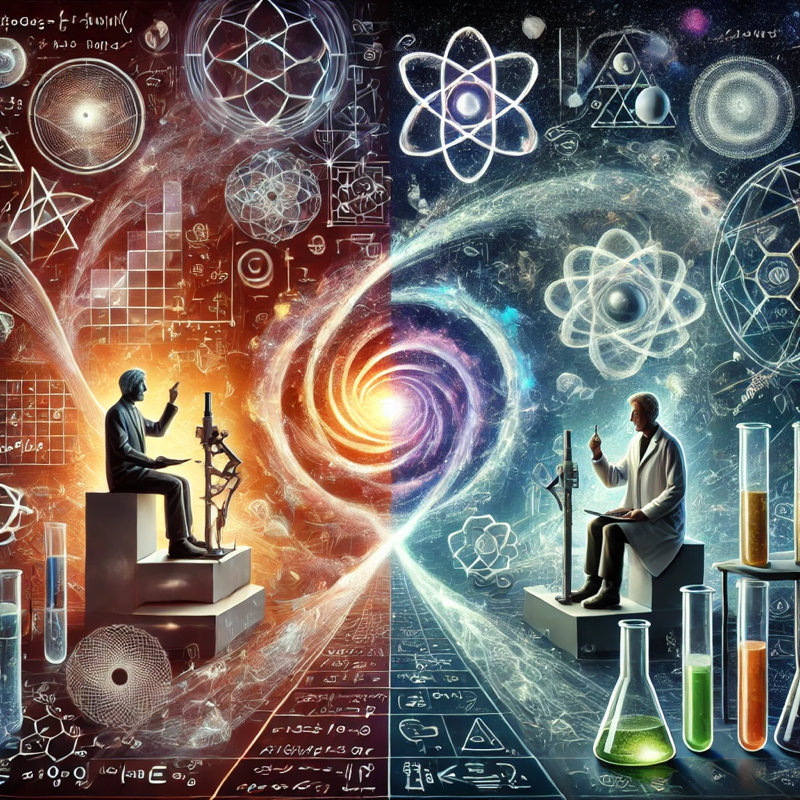
The pursuit of knowledge is a multifaceted journey, shaped by the interplay between two dominant schools of thought: rationalism and experimentalism. These approaches, while distinct, are not mutually exclusive and serve as complementary tools in humanity’s quest for understanding. Each offers unique strengths and insights but also comes with its own set of limitations, underscoring the complexity of knowledge acquisition.
Rationalism: The Realm of Reason
Rationalism, rooted in the power of the human mind, relies heavily on logical reasoning and deductive arguments to derive truths. This approach emphasizes the ability to gain knowledge independently of sensory experience, relying instead on abstract thought, innate ideas, and intellectual intuition. Rationalism shines in areas where direct observation is either impossible or impractical, such as metaphysical questions about existence, morality, and the ultimate nature of reality. For example, philosophers like Descartes used rational deduction to argue for the certainty of the self’s existence with his famous dictum, Cogito, ergo sum (“I think, therefore I am”).
Despite its intellectual rigor, rationalism is not without flaws. It often hinges on assumptions that cannot always be empirically verified, leading to the risk of circular reasoning or unfalsifiable claims. For instance, rational arguments for the existence of an immaterial soul or a supreme deity may rest on premises that themselves lack empirical validation, making such arguments persuasive yet speculative. Furthermore, rationalism’s reliance on abstract reasoning can sometimes distance it from the practical realities of the observable world.
Experimentalism: The Authority of Experience
In contrast, experimentalism anchors itself in the tangible, prioritizing empirical evidence and experimentation as the foundation for understanding. By relying on systematic observation, data collection, and hypothesis testing, experimentalism has propelled humanity’s scientific and technological advancements. The development of vaccines, the exploration of space, and the understanding of natural phenomena like gravity and evolution owe their success to this methodical approach.
However, experimentalism is not without its boundaries. Not every question can be addressed through empirical experimentation. In fields such as ethics, aesthetics, or metaphysics, where values and subjective experiences dominate, experimental methods often fall short. Furthermore, the reliability of experimental results can be compromised by observer bias, limitations in methodology, or unaccounted-for variables. While experiments strive for objectivity, the human element in their design and interpretation can introduce subjective distortions.
A Synthesis of Approaches
The dichotomy between rationalism and experimentalism is often seen as a conflict, but the most profound insights emerge from their synthesis. Neither pure reasoning nor isolated observation can fully capture the richness and complexity of the world. For instance, scientific theories often begin with rational hypotheses, which are then tested and refined through experimental methods. Likewise, empirical findings can inspire abstract reasoning, leading to broader theoretical frameworks.
The fields of medicine and psychology illustrate the interplay between these approaches. Medical diagnoses and treatments combine empirical data from tests and observations with rational interpretations to decide the best course of action. In psychology, theoretical models of human behavior are developed through rational analysis but validated through experimental studies and clinical trials.
Moreover, history demonstrates the need for balance. The Enlightenment, which championed reason and rationalism, laid the groundwork for the scientific revolution. Yet, the scientific method, which emerged in the same era, bridged the gap between speculative thought and empirical validation, enabling practical applications of abstract ideas.
The Quest for a Balanced Epistemology
The pursuit of knowledge is a nuanced endeavor that requires recognizing the strengths and limitations of both rationalism and experimentalism. Rationalism provides the conceptual frameworks and intellectual clarity needed to pose meaningful questions, while experimentalism offers the empirical validation and practical insights necessary to answer them. Together, they form a dynamic interplay that drives progress in both science and philosophy.
In an era of increasing specialization, the integration of reason and experience remains vital. By embracing both methods, we can cultivate a deeper, more holistic understanding of the world, navigating its complexities with both intellectual rigor and empirical sensitivity. Ultimately, the interplay of rationalism and experimentalism reflects the dual nature of human inquiry: a pursuit grounded in reason yet enriched by the lessons of experience.
 Maq Masi Blog
Leave a comment