
- Maq Masi
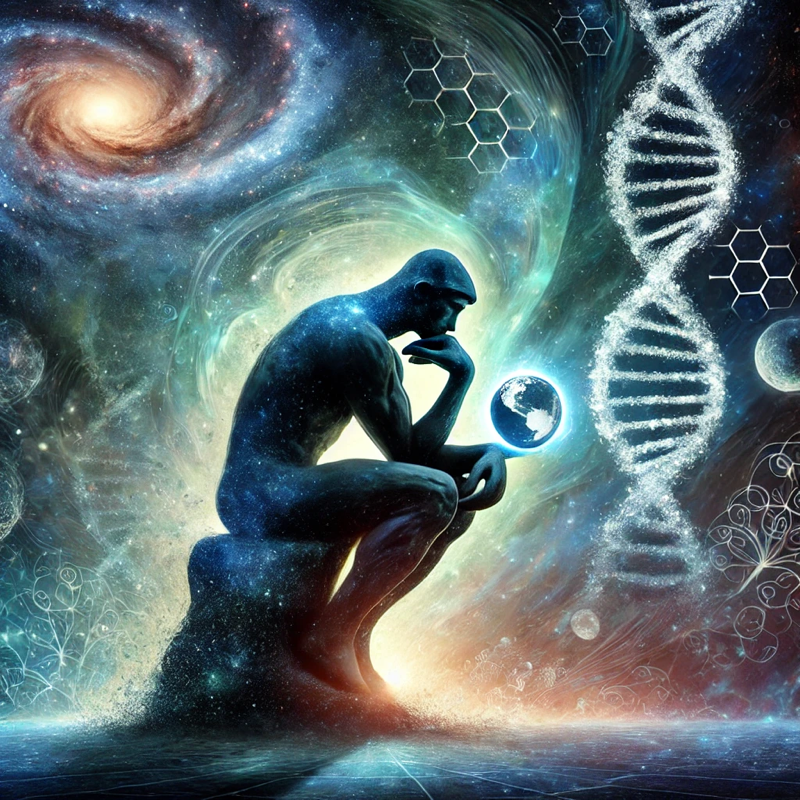
Curiosity is the hallmark of human nature, a relentless drive to understand the world around us and our place within it. Questions about the origins of life, the nature of existence, and whether there is a creator—or what created the creator—are among the most profound and timeless inquiries. This article is an exploration of these questions, aiming to satisfy the intellectual hunger of readers who, like me, seek to unravel the mysteries of existence.
Life: The Seed of Existence
Life’s emergence is both a scientific and philosophical marvel. A single seed, dormant yet full of potential, sprouts into a living plant under the right conditions. This process reflects the transformative power inherent in life. The question arises: does a seed possess life before it germinates, or does life emerge through its transformation? Science explains that the seed is a multicellular structure, its cells poised for action, waiting for water, warmth, and nutrients to trigger germination.
Similarly, the origins of life on Earth trace back to a phenomenon known as abiogenesis—the emergence of living organisms from non-living matter. Billions of years ago, Earth’s primordial soup, rich in chemicals and energy, provided the conditions for simple molecules to form complex structures like RNA, which could replicate and evolve. But what catalyzed this process? Could it be sheer chance, or was there a guiding force behind it?
The Creator and the Question of Origins
The idea of a creator often arises when contemplating the complexity of life and the universe. The intricate design of DNA, the fine-tuning of physical laws, and the interconnectedness of ecosystems seem too precise to be mere accidents. For many, this suggests a purposeful creator. Yet, this leads to the ultimate paradox: Who created the creator?
Philosophers and theologians have long grappled with this question. Some argue that a creator must exist as the uncaused cause, outside the realm of time and space, where causality begins. This creator, eternal and self-existent, requires no further explanation. Others propose that the question itself is flawed, as it applies human logic to something potentially beyond our comprehension.
Science and the Self-Sufficient Universe
Science offers an alternative perspective: the universe might not need a creator. Quantum physics has shown that particles can arise spontaneously in a vacuum, challenging the notion that something cannot come from nothing. The universe, according to this view, may be self-sufficient, governed by unchanging physical laws that enable complexity and life to emerge naturally over time.
The RNA World Hypothesis, for example, posits that self-replicating molecules formed the basis of early life, evolving into the vast diversity of organisms we see today. While this explains much about how life progresses, it doesn’t fully answer why the universe has the properties that allow life to exist in the first place.
Proposing Vibration as the Phenomenon of Life
When contemplating life and its origins, a profound realization emerges: vibration is not merely a characteristic of life; it is life itself. Vibration—at atomic, molecular, and biological levels—is a universal phenomenon that transcends the boundary between the living and the non-living. It provides a unifying framework to understand life as a dynamic, transformative process.
1. Vibration in Dormant and Active States
Every living organism, whether in an active or dormant state, is defined by its vibrations:
• Seeds: A dormant seed is not lifeless; its internal molecules vibrate subtly, preserving potential energy until conditions allow it to “awaken.”
• Ovum: The ovum’s lifespan of 12-24 hours can be extended through cryopreservation, a process that halts molecular vibrations by freezing.
• Microbes: Bacteria can remain viable for centuries in extreme environments because their vibrations are slowed, not eliminated. Reactivation occurs when environmental conditions restore energy flow.
These examples highlight that vibration is the defining phenomenon that bridges states of dormancy, activity, and revival.
2. The Superatom and Matter Transforming to Life
The behavior of matter under extreme conditions provides a tantalizing glimpse into how vibration might define life at its most fundamental level. According to the Einstein-Bose equation, when atoms are cooled to absolute zero (-273.15°C), their vibrations cease, and they transition into a superatom state, where they behave as a single, wave-like entity.
This transformation blurs the distinction between matter and energy:
• Wave-Like Properties: At absolute zero, atoms exhibit collective vibrational behavior, functioning as energy waves rather than discrete particles.
• Implications for Life: If matter can transition to a state of unified vibration, could life itself be seen as a unique vibrational phenomenon? Could altering environmental vibrations—through heat, cold, or energy input—transform non-living matter into living systems?
This hypothesis suggests that the boundary between living and non-living is not fixed but dynamic, mediated by vibrations that define energy states.
3. External Influences on Vibration and Life
The vibrational state of matter can be manipulated to influence life cycles:
1. Cryopreservation: By halting vibrations, life processes are paused, extending viability indefinitely.
2. Ecosystem Interactions: Vibrations from sound waves or electromagnetic fields can affect growth, health, and even behavior in organisms.
3. Reactivation: Seeds, microbes, and other life forms regain vitality when vibrations are restored through environmental changes.
These phenomena suggest that life, at its core, is a continuum of vibrational states modulated by external factors.
Vibration as the Transformative Force of Life
At the heart of this perspective lies a profound idea: vibration is the transformative force that animates matter, turning it into life. This view aligns with both scientific principles and philosophical traditions:
• Science explains how vibrations drive chemical reactions, biological rhythms, and energy exchange.
• Philosophy and spirituality see vibration as the universal rhythm that connects all existence, from atoms to consciousness.
In this framework, life is not a static property but a dynamic process, shaped and reshaped by the vibrational energy that permeates the universe.
Conclusion: Vibration as Life’s Essence
The questions of life, existence, and origins may never be fully answered, but their exploration reveals a fundamental truth: vibration is at the heart of life. Whether seen as the mechanism that drives molecular interactions or the rhythm that connects all beings, vibration is the thread that ties existence together.
If matter can transition into wave-like energy and vibration can sustain life through dormancy and revival, then life is not merely a state but a phenomenon—a dynamic interplay of vibrations. This understanding blurs the line between living and non-living, suggesting that life is a continuum shaped by the vibrational energy of the universe.
Perhaps the eternal answer lies not in static definitions but in the vibrational dance that sustains all existence. In every hum of an atom, every rhythm of a heart, and every transformation of matter into life, we glimpse the profound mystery of existence—a mystery defined, ultimately, by vibration.
Editor’s note: This essay has been revised to present a strictly materialist account of life and origins, removing earlier metaphysical phrasing.
Matter in Motion
Maq Masi
A seed looks like a pause button. Hard, dry, unimpressed by the drama of weather and time. Yet give it water, warmth, oxygen, and a workable patch of soil, and it becomes proof that “life” is not a magical ingredient poured into matter. It is what matter does when it is arranged in a certain way and supplied with usable energy.
That is the materialist starting point I want to commit to here. Not because it feels comforting, but because it forces discipline. It keeps the discussion anchored to mechanisms, conditions, constraints, and evidence. It also removes a common escape route: the temptation to declare the difficult parts “beyond explanation” and call that an answer.
The moment we treat life as a property of organised matter, a lot of familiar puzzles begin to change shape. The seed stops being a symbol of hidden spirit and becomes a compact engineering solution. It stores chemical potential energy, protects delicate structures from environmental damage, and slows its own chemistry to a crawl until the external world becomes favourable. That “waiting” is not mystical. It is an energetic and biochemical strategy.
The same logic appears in other biological thresholds that people often describe in spiritual language. Consider an ovum. In everyday conditions it has a narrow viable window, usually measured in hours rather than days. That limitation is not fate; it is chemistry. The cell is a complex arrangement of proteins, membranes, and molecular machinery that begins degrading the moment it is formed, because disorder is the default direction of time in a warm, reactive environment. Cryopreservation changes that environment. By dropping temperature, we reduce molecular kinetic energy, slow diffusion, and suppress reaction rates. The cell is not placed outside physics; it is forced deeper into it. Life processes become too slow to observe on human timescales, which is why freezing can feel like stopping time. What is really happening is that the biochemical clock is being deprived of the energy and mobility it needs to tick.
Microbes make the same point with less romance and more stubbornness. Certain bacteria and spores can remain viable for astonishing periods when conditions are hostile, because their metabolism becomes minimal and their structures are built to endure. In deserts, salt deposits, deep ice, and other harsh environments, you see a pattern: when energy input and molecular movement are restricted, biological activity can become so faint it looks like absence. Then, when water or heat returns, the machinery can restart. Again, this is not a supernatural “return of life.” It is a resumption of chemistry once the physical constraints are relaxed.
This is where people often reach for the word “vibration,” and I understand why. It captures something real: life tracks motion. At a basic level, biology is controlled molecular motion. Enzymes bind, bend, and release. Ions cross membranes. Proteins fold and unfold. DNA is copied by molecular machines that depend on collisions, temperatures, concentration gradients, and the geometry of surfaces. If you remove motion, you remove the ability to do work.
But a strict materialist has to be precise. Vibration is not a special life-force. It is a generic feature of matter. Molecules vibrate, solids carry lattice vibrations, and heat is, in large part, the statistical behaviour of enormous numbers of vibrating and translating particles. A rock contains motion. A flame contains motion. The difference is not that living matter “vibrates” and non-living matter does not. The difference is that living systems channel motion into self-maintaining organisation.
That distinction matters because it stops us falling into a neat-sounding but misleading claim: “life is vibration.” A better statement, and a truer one, is that life is organised energy flow through matter. Living systems persist by staying out of equilibrium. They take in energy and materials, do work, and export waste and heat. They are temporary islands of order built and rebuilt against a tide of disorder. That is not poetry, it is thermodynamics wearing a biological mask.
Once you see life that way, the seed is no longer a metaphor for hidden essence. It becomes a demonstration of a principle: organisation can be maintained with minimal activity if the system is well-designed and the environment is restrictive enough. Dormancy is not the absence of life; it is the minimisation of life’s costs.
Extreme physics adds another useful layer to this picture, but it needs handling carefully. When matter is cooled to extremely low temperatures, thermal motion is drastically reduced and quantum effects can become macroscopic. In laboratories, physicists can create Bose–Einstein condensates, states where large numbers of atoms occupy the same quantum state and behave coherently. It is tempting to describe this as “vibrations ceasing” and atoms forming a “superatom,” but the reality is subtler. Thermal noise is suppressed, yet quantum motion does not disappear. Even at temperatures approaching absolute zero, zero-point energy remains. What changes is not that motion ends, but that the character of motion becomes more coherent and less chaotic.
Why does this matter for a materialist account of life? Because it reminds us that “state” is everything. Matter can behave like discrete particles in one regime and like a coordinated wave-like system in another. The same atoms, different conditions, different collective behaviour. That is exactly the kind of logic biology runs on, only at warmer temperatures and vastly greater complexity. Life is not made of special matter. It is made of ordinary matter in an extraordinary state of organised activity.
If we keep the focus on state and organisation, the discussion about life’s origins becomes clearer as well. Abiogenesis, as a research programme, is not one story but many competing pathways trying to bridge the same gap: how chemistry on the early Earth could have produced self-sustaining, self-copying systems capable of evolution. Some hypotheses emphasise RNA-like molecules because they can, in principle, store information and catalyse reactions. Others focus on metabolism-first ideas, where networks of reactions form before genetics becomes dominant. Others emphasise compartments, such as lipid membranes, because a boundary is essential: you cannot have a stable “self” without a way of separating inside from outside.
All of these approaches share a materialist core. They treat life as an emergent property of chemical systems under certain energy conditions. The early Earth offered energy gradients everywhere: heat from geothermal sources, radiation from the Sun, chemical gradients around hydrothermal vents, cycles of wetting and drying, freezing and thawing. Those gradients are not background scenery. They are the engine. Without a gradient, there is no work to be done. With gradients, matter can be pushed into complex arrangements that would not form in equilibrium.
This is also where the idea of “external influences” needs to be framed properly. Temperature is not merely a factor; it sets the speed of chemistry. Light is not merely illumination; it is energy input capable of driving reactions. Electromagnetic radiation can damage biological molecules or, in controlled contexts, provide energy for processes such as photosynthesis. Sound, as mechanical vibration, can influence living tissues under certain conditions, although popular claims about “sound frequencies healing everything” tend to outrun evidence. A materialist approach is not hostile to unusual influences; it simply insists on mechanism and repeatability before it grants importance.
In that framework, cryopreservation is not a philosophical wonder. It is an applied lesson in kinetics. Dormancy in seeds is not an existential riddle. It is a stabilised low-energy mode of an organised system. Microbial survival in extremes is not “life triumphing over death.” It is robust molecular architecture plus very slow chemistry.
Now, what about the larger question that always hovers behind these discussions: the origin of everything?
A materialist has to be honest about what science can and cannot currently do. Modern cosmology describes the universe evolving from a hot, dense early state and expanding over time. It models how matter formed, how stars and galaxies formed, and how the chemical elements required for biology were forged. It gives us a powerful narrative of transformation without needing to invoke an external designer.
But the urge to ask “what caused the universe?” does not disappear. A strict materialist response is not to mock the question, but to clarify it. Causality, as we experience it, is a rule inside the universe: events follow other events in time under physical laws. When we ask for a cause “before” the universe, we may be demanding a type of explanation that assumes time already exists. If time is part of the physical system that began evolving from that early state, then “before” may not be a meaningful category in the way we instinctively want it to be.
This is also why the “creator” move does not solve the puzzle. If you assert a creator to explain existence, you have not removed the mystery; you have relocated it. You still have to explain what kind of thing a creator is, how it exists, and why it exists. From a materialist standpoint, adding an extra entity that cannot be measured or constrained is not an explanation, it is an expansion of the unknown.
A more disciplined stance is to treat the deepest level of reality as something we may eventually describe in terms of fundamental laws, boundary conditions, or deeper theories that unify what currently looks separate. It is possible that there is an answer to why there is something rather than nothing. It is also possible that “something” is the default, and “nothing” is the concept that requires special justification. Either way, the materialist commits to answering with the tools that have consistently expanded human understanding: observation, modelling, and critical testing.
So where does that leave the seed in the palm?
It leaves it exactly where it belongs: not as a symbol of the supernatural, but as a compact, physical argument. It says that life is not a mystery substance. It is a pattern that matter can enter when energy flows through it in the right way. It says that the boundary between active and dormant is a matter of rates and constraints, not essence. It says that what we call “alive” is best understood as a system that keeps itself going by constantly managing energy, repairing damage, and maintaining structure against decay.
That is a demanding view, but I find it more respectful than vague comfort. It respects the complexity of living systems enough to study them properly. It respects the universe enough to avoid flattering ourselves with unfalsifiable stories. And it respects human curiosity not by pretending we already have final answers, but by treating questions as problems that can be refined, tested, and—sometimes—solved.
The seed does not contain a hidden spirit waiting to be released. It contains stored resources, information encoded in molecular structures, and an architecture evolved to survive a pause. When conditions return, the chemistry restarts and the pattern continues. Life, seen this way, is not magic. It is matter behaving with extraordinary persistence under the ordinary rules of physics.
 Maq Masi Blog
Leave a comment