- Maq Masi
Abstract
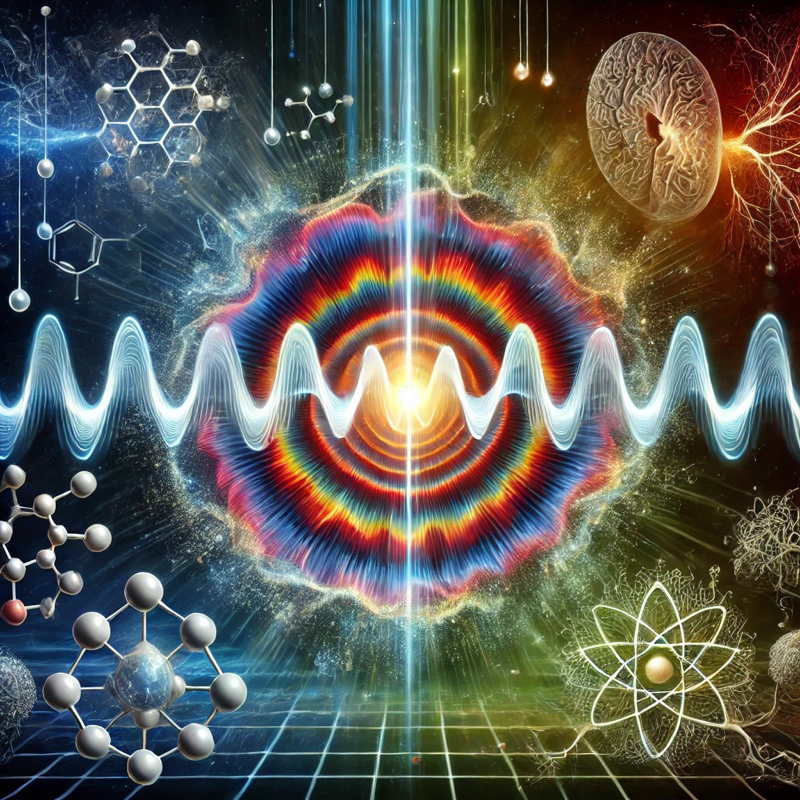
This paper proposes the hypothesis that vibration is the foundational origin of matter, life, and the universe. I argue that vibration serves as the primary force driving creation, transforming latent potential into tangible existence. Existing theories such as the Big Bang and Steady-State models, while groundbreaking, leave critical questions unanswered: What caused the origin of the universe? How did something emerge from nothing? How do life and consciousness arise from non-living matter? This study posits that vibration is not merely a physical phenomenon but a noumenon—a self-originating, intrinsic force capable of bridging the divide between nothing and something. By examining the interdisciplinary role of vibration across physics, chemistry, biology, and neuroscience, this paper demonstrates that vibration is the unifying principle underlying existence, with profound implications for both theoretical understanding and practical applications.
Introduction
The origins of the universe, matter, and life are among the most profound questions of human inquiry. How did the universe begin? What transformed lifeless matter into living organisms? How do these seemingly separate phenomena interconnect?
Traditional scientific models offer partial answers:
1. The Big Bang Theory describes the universe’s expansion from a singularity but fails to explain the singularity’s origin.
2. The Steady-State Theory postulates an eternal universe but contradicts empirical evidence of cosmic evolution.
Both theories leave fundamental gaps, particularly in addressing the transition from nothing to something. This paper introduces an alternative perspective: vibration as the fundamental force driving creation. Unlike existing models, the vibration hypothesis proposes that vibration inherently transforms latent potential into energy, mass, life, and consciousness. It bridges the divide between non-existence and existence, offering a unified explanation for the origins of everything.
Critique of Existing Theories
The Big Bang Theory
The Big Bang Theory is the dominant cosmological model, positing that the universe began approximately 13.8 billion years ago as a singularity—a point of infinite density and temperature. While this theory successfully explains the universe’s evolution, it fails to address key questions:
1. What Caused the Big Bang?
The theory provides no explanation for what initiated the expansion of the singularity.
2. What Existed Before the Big Bang?
The absence of time before the Big Bang renders the concept of “before” meaningless, leaving the origin itself unexplained.
3. How Did Something Emerge From Nothing?
The Big Bang Theory does not clarify how the singularity—or the energy it unleashed—arose from a state of “nothingness.”
The Steady-State Theory
The Steady-State Theory suggests that the universe has always existed, with matter continuously created to maintain a constant density. However, this model is inconsistent with empirical observations:
1. Cosmic Microwave Background Radiation: Evidence of residual energy from a finite origin contradicts the idea of an eternal universe.
2. Galactic Evolution: Observations of star formation and galactic clustering indicate a universe with a dynamic, finite history.
3. Undefined Mechanism of Matter Creation: The theory offers no scientific basis for the continuous creation of matter.
The Vibration Hypothesis: Transforming Nothing Into Something
The vibration hypothesis posits that vibration is the intrinsic force that transforms nothing into something. Unlike existing theories, it provides a mechanism for creation that does not rely on external causes or pre-existing space-time frameworks.
1. Nothing as Latent Potential
Philosophically, “nothing” cannot truly exist because its very definition implies the potential for “something.” This potential is not an absence but an unstable equilibrium, capable of generating fluctuations. Vibration arises from this latent instability, converting potential into dynamic existence.
2. The Role of Vibration
Vibration serves as the bridge between non-existence and existence:
• Spontaneous Activation: Fluctuations in “nothingness” give rise to vibration, which self-perpetuates without external cause.
• Energy Emergence: Vibration generates energy through oscillatory motion, creating the foundation for physical phenomena.
• From Energy to Mass: Vibrational frequencies condense energy into mass, following principles analogous to Einstein’s .
• From Mass to Life: Vibration drives the organization of matter into increasingly complex structures, culminating in life and consciousness.
The Role of Vibration Across Disciplines
Physics: The Foundation of Existence
• Wave-Particle Duality: Vibrations underlie the wave-like behavior of particles, connecting quantum mechanics to macroscopic phenomena.
• String Theory: Vibrating strings are proposed as the building blocks of matter, aligning with the vibration hypothesis.
• Cosmic Origins: Vibration explains the emergence of energy, mass, and structure in the universe.
Chemistry: The Mechanism of Interaction
• Molecular Vibrations: Vibrational energy enables chemical bonding and reactions, facilitating the creation of complex molecules.
• Catalysis: Vibrations lower activation energy, enhancing reaction rates critical to life’s emergence.
• Energy Conversion: External vibrations influence chemical states, enabling molecular transformations.
Biology: The Rhythm of Life
• Cellular Vibrations: Vibrations sustain cellular functions, including metabolism and replication.
• Dormancy and Reactivation: Subtle vibrations allow dormant life forms, such as seeds and microbes, to revive under favorable conditions.
• Biological Rhythms: Heartbeats, circadian rhythms, and brainwaves demonstrate life’s vibrational nature.
Consciousness: The Vibration of Thought
• Neural Oscillations: Brainwave activity reflects vibrational harmonization within neural networks, linking vibration to cognition.
• Sensory Perception: Vibrations in light and sound shape sensory experiences, tying consciousness to external vibrational phenomena.
• Consciousness as Resonance: Thought and awareness emerge from the synchronized vibrations of neural circuits.
Practical Applications of Vibration
1. Medicine: Vibrational Therapies for Healing and Regeneration
• Low-Intensity Pulsed Ultrasound: Promotes bone healing and cellular regeneration by enhancing vibrational activity.
• Electromagnetic Therapies: Pulsed electromagnetic fields stimulate tissue repair and reduce inflammation.
• Sound Therapy: Synchronizes brainwaves to reduce stress and enhance mental health.
2. Energy: Harnessing Vibrational Energy
• Piezoelectric Materials: Convert mechanical vibrations into electricity for sensors and energy systems.
• Thermoacoustic Generators: Use sound vibrations to produce thermal and electrical energy.
3. Neuroscience: Enhancing Consciousness
• Binaural Beats: Modulate brainwave frequencies to improve focus and relaxation.
• Transcranial Magnetic Stimulation: Uses electromagnetic vibrations to treat neurological disorders.
The Cause of Creation: Addressing Criticism
The vibration hypothesis eliminates the need for an external cause by positing that vibration is self-originating and timeless:
1. Philosophical Basis: Nothingness inherently contains the potential for something; vibration activates this potential.
2. Scientific Evidence: Quantum fluctuations demonstrate that energy can spontaneously arise from a vacuum, mirroring the self-creating nature of vibration.
3. Timeless Resonance: Vibration operates outside the constraints of time and space, existing as a perpetual force.
Conclusion: The Symphony of Existence
The origin of the universe, matter, and life lies in the self-originating force of vibration. Unlike the Big Bang and Steady-State Theories, which leave gaps in causality and mechanism, the vibration hypothesis provides a cohesive explanation for the transition from nothing to something.
By uniting physics, chemistry, biology, and consciousness, the vibration hypothesis redefines existence as a timeless symphony, where vibration is both the instrument and the melody. It bridges the tangible and intangible, offering profound insights into the interconnectedness of all things and opening new frontiers for scientific exploration and practical innovation.
 Maq Masi Blog
Leave a comment