
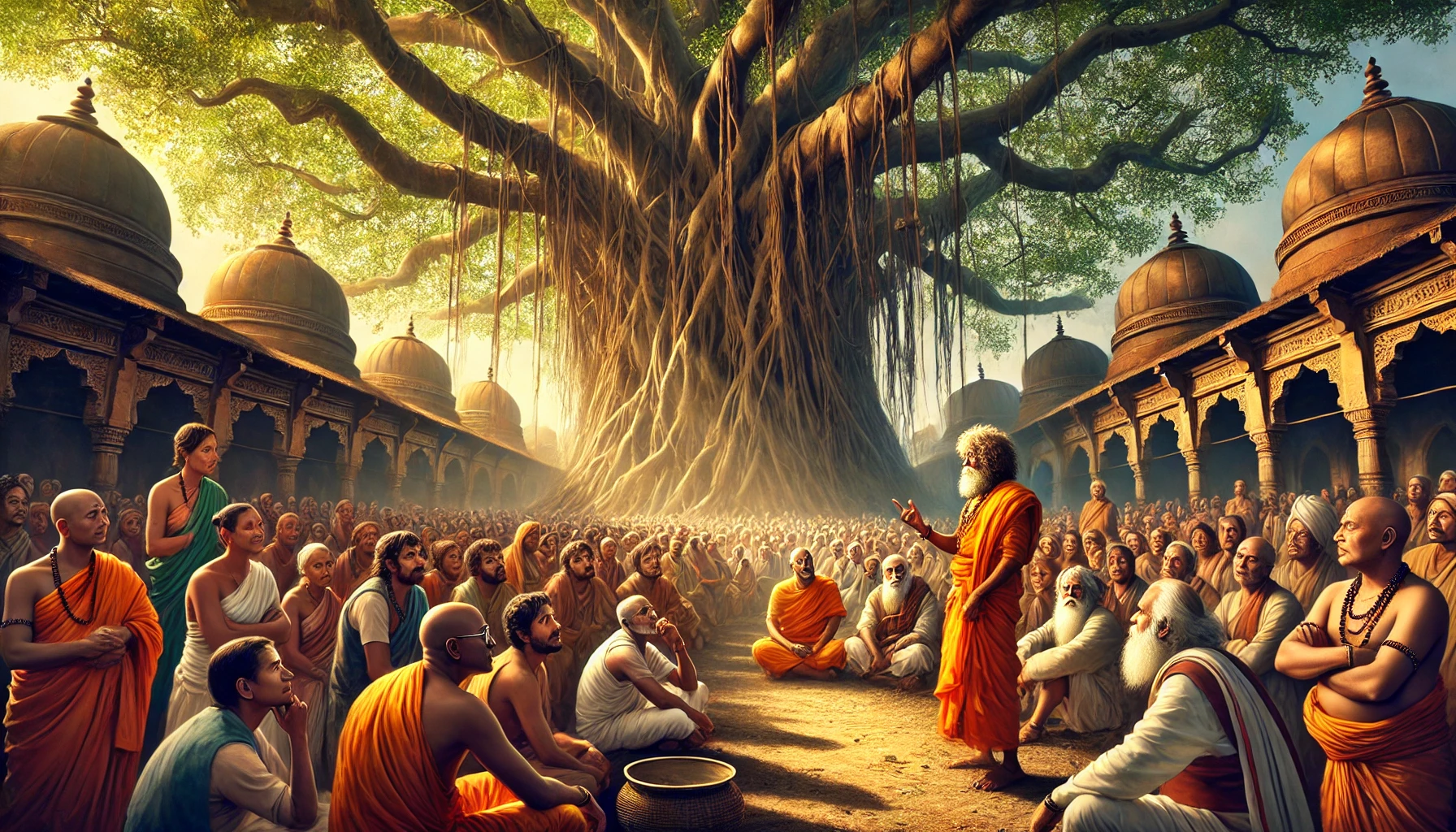
The late afternoon sun bathed the bustling marketplace of Vaishali in gold, its light filtering through the sprawling branches of a massive banyan tree. Vendors called out prices for silk, grain, and spices, while children darted between stalls, their laughter mingling with the hum of trade. Beneath the banyan’s deep shade stood a lone figure—wild-haired, his coarse garment blending with the earth. His piercing gaze swept over the crowd, defiant yet searching, drawing curious glances as he leaned casually against the tree’s trunk.
A merchant haggling over a sack of rice froze mid-gesture as the figure’s voice rang out, cutting through the noise like a blade.
“Why chant to gods who neither speak nor act, when the grain you hold sustains life?”
Heads turned, conversations halted, and even the clinking of coins fell silent. All eyes now focused on the man, whose presence seemed to demand a response.
Seated cross-legged near the tree’s roots, a Vedantic scholar raised his head, his ochre robes luminous in the fading light. Beads in hand, his disciples murmured verses from the Upanishads, their chants faltering as the scholar stood. His gaze met the wanderer’s, calm but edged with authority.
“You speak boldly, stranger,” he said, his voice steady. “But boldness without wisdom is folly. This world you cling to is an illusion—Maya—sustained by Brahman, the eternal truth.”
The man stepped forward, his movements deliberate. The fire in his eyes burned brighter as he tilted his head slightly.
“Illusion?” he said, his voice rising. “Are your hunger, sweat, and breath illusions? If Brahman sustains all, show me—let me touch it, hear it, see it! Or are your gods just stories to keep men obedient to fate?”
The crowd murmured, a ripple of unease spreading among the listeners. The merchant clutched his rice sack tighter, his curiosity locked on the exchange.
The scholar remained composed. “Brahman is beyond form, beyond senses,” he said. “It is the infinite reality beneath this transient world.”
The man’s laughter rang out—not mockingly, but raw and unrestrained.
“Yet here you sit, cloaked in wealth, claiming the world is false while teaching others to renounce it. Preach surrender, and people kneel—it’s easier to rule the obedient.”
A Buddhist monk stepped forward from the edge of the gathering, his saffron robes glowing in the dying light. His movements were deliberate, his gaze serene but unwavering.
“Desire is the root of suffering,” the monk said. “The Buddha teaches that clinging binds us to the cycle of birth, death, and rebirth. To live free of suffering, one must extinguish desire.”
The man regarded the monk for a moment, his expression softening briefly before turning sharp again.
“You fear desire because it brings pain—but also joy, love, and life itself! Without it, you would not eat or breathe. If life is suffering, why live at all?”
The monk’s voice remained calm. “Life is both suffering and the path to liberation. Desire extinguished brings peace.”
The man’s voice rose like a flame catching wind.
“Peace in nothingness? A world without longing is a world without meaning. Your so-called liberation is a death disguised as wisdom.”
A Jain ascetic, clad in white and sweeping the ground with a small broom to avoid harming even the smallest creatures, now stepped forward. His voice, though quiet, carried conviction.
“Your words wound, but your heart is restless. Nonviolence—Ahimsa—is the way. To harm another is to harm oneself. Harmony lies in restraint.”
The man turned to him, his smirk fading into a colder expression.
“Harmony? Life feeds on life. Does your breath not kill unseen creatures? Does your stomach not destroy the grains you eat? To live is to harm. Intent will not change the fate of what you consume.”
The ascetic replied firmly, “We do not claim perfection but strive to minimize harm. It is not denial—it is discipline.”
The man stepped closer, his eyes locking with the ascetic’s.
“Discipline is another word for fear—fear of karma, of death, of consequence. But I tell you, there are no cosmic scales, no punishments or rewards. There is only this life, lived in its brutal beauty.”
The crowd stood spellbound, the hum of the marketplace fading into silence. The merchant forgot his bargaining, the farmer abandoned his plow, and even the vendors paused, their cries stilled by the weight of the moment.
The man spread his arms, addressing them all.
“You live in chains—chains of faith, promises of salvation, threats of damnation. I offer you freedom. Lokayata—this world, here and now. Live without fear, for this life is all there is!”
Without waiting for a response, the man turned and walked away, his coarse garment blending into the dust of the market. The banyan tree, its roots anchored deep and its branches stretching wide, stood as it always had—a silent witness to the clash of ideas, the tremors of belief. Under its shade, the people of Vaishali stood divided, some clutching their faith tighter, others questioning for the first time.
As the last rays of the sun disappeared, the banyan’s shadow lingered, stretching over a marketplace that would never forget the firebrand who dared to ask what they feared to answer.
 Maq Masi Blog
Leave a comment