The sun was setting, painting the sky in hues of crimson and gold, as Arvind sat on the verandah of his ancestral home, his eyes lost in the horizon. The sprawling fields before him, cultivated with generations of sweat and dreams, now seemed quiet—too quiet. Inside the house, the faint sounds of dinner being prepared echoed through the open windows. A home that once brimmed with laughter and trust now carried an air of unease, like a storm cloud that refused to move on.
Arvind had always been a man of principles. A thinker, a father, and a mentor, he had raised his children with values rooted in morality, ethics, and a profound respect for life. Dinner table discussions were often philosophical, debates were encouraged, and questions welcomed. His family thrived on ideas, on seeking truths that went beyond material things.
Among his children, it was Rohan—his youngest—who shone brightest in Arvind’s eyes. Loyal, hardworking, and family-oriented, Rohan carried the family’s legacy with pride. If ever Arvind looked to the future, it was Rohan he saw standing tall, carrying the torch of the family name.
But every trust, however sacred, rests on a fragile balance.
It began with whispers—tiny hints of change that Arvind dismissed as the winds of youth. Rohan, once eager to share his thoughts and stories, had grown quiet. He would return late from gatherings with his friends, his laughter replaced by an unfamiliar heaviness. Arvind noticed the signs but brushed them off as growing pains, the natural distance that comes when a child begins to carve out his own world.
Then one evening, Arvind found it. A crumpled pack of cigarettes and a rolled-up vid tucked into the corner of Rohan’s study drawer. His hands trembled as he unfolded them, as though the weight of it was heavier than anything he had carried in his life. Smoking was never just a bad habit in his family; it was a symbol of surrender—a surrender of discipline, clarity, and respect for the life gifted to them.
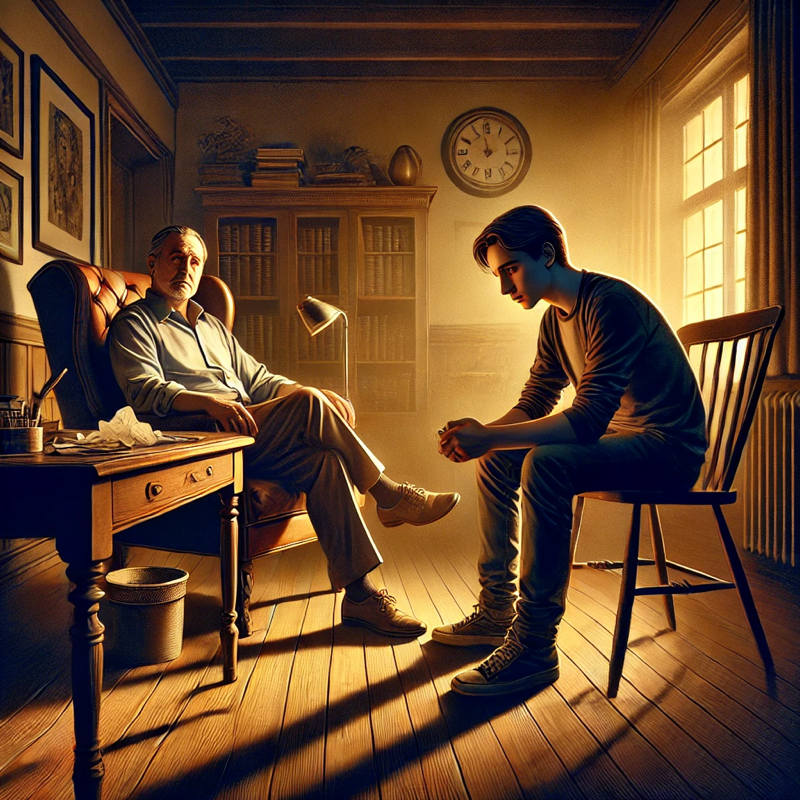
The confrontation came the next day after dinner. Arvind called Rohan to his study, his voice calm but stern. Elara, Rohan’s mother, sat in the corner, her eyes already glassy with unshed tears.
“Sit, Rohan,” Arvind said, gesturing to the chair across from him.
Rohan hesitated, his face a mixture of guilt and defiance. He knew.
Arvind held up the cigarettes first. “Is this who you are now?”
Rohan looked away, his jaw tightening.
“And the vid,” Arvind continued, his voice breaking slightly. “Who showed you this path, son?”
“It’s not like that, Baba,” Rohan muttered, but his voice was unconvincing, almost lost.
Arvind’s gaze didn’t falter. “Then tell me. Who whispered this nonsense into your life?”
After a pause, Rohan said a name—his friend. Arvind had always been wary of this boy, someone who lingered at the edges of their family gatherings, whose charm felt hollow, whose influence felt sharp. He had warned Rohan, gently but firmly, to choose his company wisely.
“You let yourself be manipulated,” Arvind said, softer now but laced with disappointment. “You let someone fill your mind with shadows, and for what?”
Rohan’s head dropped as his voice cracked, his rebellion softening into anguish. “I didn’t mean to… I didn’t want to disappoint you. I just—” He paused, looking up with tears brimming. “He made me feel… alive. Free. Like I didn’t have to live up to everything—this house, this name, this life. I didn’t know I needed that until he showed me.”
Elara’s heart ached, her voice trembling as she whispered, “Rohan, we built this life for you. We sacrificed everything so you could live freely, not to see you throw it all away.” Her hand rested on Arvind’s shoulder, her touch grounding his silent grief. She looked at her husband’s hunched frame, his shoulders drooping under the weight of trust betrayed.
Later that night, long after Rohan retreated to his room, Arvind and Elara sat together in the dim light of their study, the ticking of the clock echoing like an accusation.
“What if he doesn’t change, Elara?” Arvind’s voice was heavy. “What then? All our sacrifices, all the years we gave to build this—was it in vain?”
Elara stared at the family photographs lining the shelves, each picture a moment frozen in time—when dreams felt unshakeable, when love had been enough to keep everything in place. “What do we do with it all, Arvind? This home, this land, this wealth. If we’ve failed at what truly matters—what’s it all worth?”
For the first time, Arvind spoke aloud the unthinkable. “We could leave. Sell this place, the land, everything we built. Move somewhere far, somewhere quiet. Because living with Rohan like this—it’s not just painful, Elara. It’s harmful. To us, to our minds, our health. If he won’t see the truth, what is left for us here? What kind of life is it to watch everything you built crumble before your eyes?”
Elara swallowed, unable to answer, but the thought clung to her like a shadow. In her heart, she murmured to herself, How could my Rohan, my sweet boy, lose himself like this? She had never imagined such a day, a day where leaving felt easier than staying.
The next morning, Arvind entered Rohan’s room, where he lay silently in bed, staring at the ceiling. Arvind sat beside him, his voice calm but resolute. “Rohan, if I did what you did—if I let someone mislead me, if I smoked and gave in—what lessons would I leave for you? Freedom is not doing whatever pleases us, son. True freedom comes from knowing who you are, from standing strong against those who try to pull you away from yourself.”
Rohan turned his head, his expression weary. Arvind pressed on. “Do you think these friends care for you? They are jealous of what we have built—our success, our values, our unity. They wish to puncture it, to see you stumble so they can feel better about their failures.” Arvind paused, his gaze unwavering. “And what about your future? Your children, when you have them someday—what will you give them? Cigarettes, vices, ruined health? What if they do what you’ve done now? Will you be able to bear that?”
Rohan’s eyes welled up again, his breath shaky. He turned away, as if the questions pierced through every layer of his defenses.
Outside the door, Elara stood listening, her heart breaking for both father and son. That night, as she lay awake beside Arvind, she whispered in the dark, “If he doesn’t see, Arvind, we’ll have to leave. I can’t watch him destroy himself while we break under the weight of it.”
In the quiet of the night, as Arvind lay staring at the ceiling, he realized something profound: love—though bruised and betrayed—was the only thing strong enough to mend what had cracked. If Rohan had been led astray, then it was their love, their unrelenting faith in him, that would guide him back.
The days that followed were slow and heavy, each one a test of patience and hope. Arvind watched his son quietly, searching for signs of change, of realization. Small steps—hesitant at first, but steps nonetheless—began to appear. Trust, Arvind knew, was like glass. Once broken, the cracks remained. But glass, when cared for, could still hold light.
And so, with hearts weighed down by hurt but lifted by love, a family began to rebuild itself. Outside, the sun rose over the sprawling fields, the shadows of yesterday softening into a new dawn.
 Maq Masi Blog
Leave a comment