
– By Maqbool Masi
The Momin Patel, also known as Momna, Mumna, or Momina, are a vibrant Muslim community primarily residing in Gujarat, India, with smaller populations in Maharashtra, Tamil Nadu, and Pakistan (Sindh and Karachi). Their name, derived from the Arabic mu’min (believer), reflects their Islamic identity, encompassing Sunni and various Shia sects, notably Nizari Ismaili (Jafari). This article explores the Momna community’s origins, their conversion from various Hindu castes to Islam, key historical figures, and their socio-cultural practices, drawing on the Gazetteer of the Bombay Presidency (1879–1880) and contemporary sources. It highlights the pivotal role of Syed Imamshah (born January 12, 1431), who named converts Momin at Pirana near Ahmedabad, and the spiritual legacy of Pir Mashayakh Bawa (born April 14, 1650; died October 24, 1690), whose ancestry traces to Pir Hasan Kabiruddin via Rehmatullah Shah, with diverse followers in Sabarkantha, Mehsana, Banaskantha, Kheda, Ahmedabad, Saurashtra, and the UK.
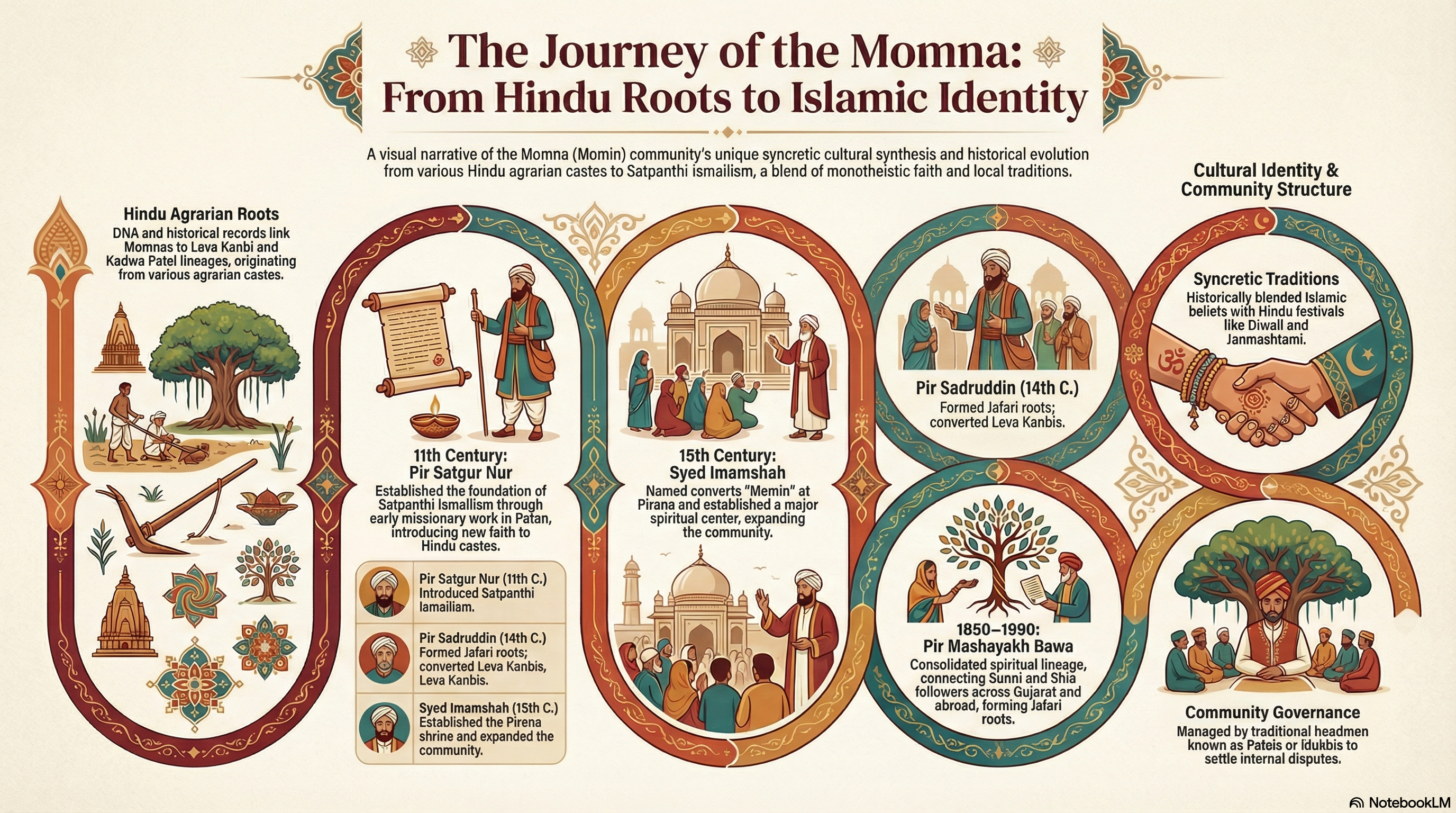
Origins: Conversion from Various Hindu Castes
The Momna community descends from various Hindu castes in Gujarat, converted to Islam between the 11th and 15th centuries through Ismaili and Sufi missionary efforts. The Gazetteer of the Bombay Presidency, Volume V: Cutch, Palanpur, and Mahi Kantha (1880) states that Momnas are “descendants of Hindus of various castes,” specifically noting that Kutch Momnas were primarily converted from the Leva Kanbi caste (Campbell, 1880, p. 47). The Gazetteer, Volume IV: Ahmedabad (1879) describes Ahmedabad Momnas as Shia Imam Shahis, converted by Bokhari Syeds, suggesting a broad base of Hindu castes who adopted Ismaili practices (Campbell, 1879, pp. 80–100).
The conversion process began with Pir Satgur Nur in the 11th century, sent by Fatimid Imam Mustansirbillah I to Patan (Anhilwad). He converted Hindu communities to Satpanthi Ismailism, a syncretic tradition blending Islamic monotheism with Hindu rituals, naming them Satpanthi (followers of the True Path) (Ismaili.net, 2025). This laid the foundation for later conversions in the 14th and 15th centuries, driven by missionaries like Pir Sadruddin, Pir Hasan Kabiruddin, and Syed Imamshah.
Key Figures in Conversion
Pir Satgur Nur (11th Century)
Pir Satgur Nur’s missionary work in Patan marked the earliest recorded conversions of various Hindu castes to Ismailism in Gujarat. His efforts established Satpanthi Ismailism, forming the basis of the Momna identity (Simerg, 2020).
Pir Sadruddin (14th Century)
Pir Sadruddin, active in the 14th century, operated during Gujarat’s Muslim rule under governors like Zafar Khan (d. 1403) and Ahmad I (d. 1442), who suppressed Shiism. Practicing taqiyyah (pious circumspection), Sadruddin converted various Hindu castes, including Leva Kanbis, to Ismailism, calling them Momin (believers). His devotees paid dues to his masnad (seat) in Gujarat, establishing the Momna’s Jafari roots (Ismaili.net, 2025; Campbell, 1880, p. 47).
Pir Hasan Kabiruddin (1341–1449)
Pir Hasan Kabiruddin, Sadruddin’s son, born in Uchh Sharif, was a transformative figure in the 14th–15th centuries. Known as Hasan Dariya, he was renowned for his piety, vegetarianism, and composition of ginans (devotional hymns). Shaikh Abdul Haq Mohadis Dehlvi’s Akhbar al-Akhayar (1590) praises his “greatest miracle” of converting “sizable to Islam,” including various Hindu castes. His simple lifestyle resonated with Gujarat’s agrarian communities, facilitating their embrace of Islam and paving the way for his son’s efforts (Ismaili.net, 2025).
Syed Imamshah (Born January 12, 1431)
Syed Imamshah, a son of Pir Hasan Kabiruddin and brother of Rehmatullah Shah, was pivotal in the 15th century. Based at Pirana near Ahmedabad, he converted 500–600 Hindu families in Sidhpur and Patan to Satpanthi Ismailism, naming them Momin (Wikipedia, 2025; Bharatpedia, 2025). Syed Mashaik , influenced smaller groups, some of whom adopted Sunni or other Shia practices, contributing to the Momna’s religious diversity (Wikipedia, 2025). The Gazetteer credits Imamshah with Kutch Momna conversions, noting their migration to Shikra in Vagad after a 1691 Gujarat revolt (Campbell, 1880, p. 47).
Pir Mashayakh Bawa (1650–1690)
Pir Mashayakh Bawa, born on April 14, 1650, and died on October 24, 1690, is a significant figure in the Momna spiritual tradition. His writings document his descent from Pir Hasan Kabiruddin through Rehmatullah Shah, a cousin of Syed Imamshah and one of Hasan’s eighteen sons (Diwan-e-Mashayakh, 2025). Mashayakh Bawa’s followers, spanning Sunni and various Shia sects (including Nizari Ismailis), are located in Sabarkantha, Mehsana, Banaskantha, Kheda, Ahmedabad, Saurashtra, and reportedly the UK, reflecting the Momna’s diverse religious landscape. His works, available at Diwan-e-Mashayakh (https://www.diwan-e-mashayakh.com/books/2-18/index.html),
Following ancestry tree offer valuable insights into lineage between Imamshah and Pir Mashayakh bawa.
Sadruddin
└── Hasan Kabiruddin
└── Imamshah (Pirana, 12 Jan 1431)
└── [Reference: https://pirimamshahbawa.org]
[Another Line – Reference: Diwan-e-Mashayakh]
Lineage from Pir Sadruddin to Pir Mashayakh Bawa (R.A.)
Pir Sadruddin
└── Pir Hasan Kabiruddin
└── Syed Rehmatullah
└── Pir Mashayakh (Big)
└── Syed Abul Hasan
└── Syed Jaimuddin
└── Syed Sadruddin
└── Syed Mohammad Razi Shah
└── Pir Mashayakh Bawa (born 14 April 1650 – died 24 October 1690)
Conversion Narratives and Historical Context
The Gazetteer provides detailed conversion narratives for Kutch Momnas:
- Imamshah’s Role: One account attributes their conversion to Syed Imamshah, who targeted various Hindu castes, particularly Leva Kanbis, in Gujarat.
The Momna revolt of 1685 is recorded in The History of Aurangzib (Vol. V, pp. 434–435). Following their defeat, some fled to Kutch, settling in Shikra and Vagad (Campbell, 1880, p. 90). - Pir Sadruddin’s Influence: Another account credits Pir Sadruddin, who converted Hindu castes, including Leva Kanbis, calling them Momin. Sadruddin became their independent pontiff, with devotees paying dues to his masnad in Gujarat (Campbell, 1880, p. 47).
- Miraculous Conversion: Kutch Momnas believed their Hindu ancestors, notably Leva Kanbis, were converted at Atari in Patan by a Syed Sadruddin who miraculously transported them to the Ganges and back, inducing them to embrace Islam (Campbell, 1880, p. 90).
These narratives highlight the diverse missionary efforts targeting Gujarat’s various Hindu castes, particularly Leva Kanbis, as recorded in the Gazetteer.
The conversion process was shaped by Gujarat’s political turmoil:
- Solanki and Vaghela Dynasties (11th–13th Centuries): The decline of the Solanki dynasty under Kumarapala (1143–1173) and the Vaghela branch’s struggles against Muslim invaders (e.g., Alauddin Khalji’s generals in 1298) created a volatile environment, enabling missionary activities (Ismaili.net, 2025).
- Gujarat Sultanate and Mughal Rule (14th–17th Centuries): Rulers like Zafar Khan (1391–1407) and Ahmad I (d. 1442) suppressed Shiism, forcing missionaries to practice taqiyyah. Mughal persecution, particularly under Aurangzeb (1658–1707), pressured Jafari Momnas to adopt Sunni Hanafi Islam or migrate, contributing to their religious diversification (Wikipedia, 2025).
Socio-Cultural Practices and Community Structure
The Momna community’s syncretic identity blends Islamic and Hindu elements, reflecting their Hindu caste origins:
- Religious Practices: Kutch Momnas, described as “Musalmans in little more than name,” avoided circumcision, daily prayers, and Ramadan fasting. They celebrated Hindu festivals like janmashtami and diwali, used greetings like Johar juhar (Shravak phrase) or Ram Ram, and marked births with a gulal cross. They devoted one-twentieth of their income (cultivators) or a rupee yearly (laborers) to Imamshah’s Pirana shrine, with some revering Sadruddin’s masnad or local saints like Babo Veto and Kangad at Shikra (Campbell, 1880, p. 47).
- Community Governance: In Kutch, Momnas formed a separate body with a headman (patel) in Mankuva, who settled disputes, fined offenders, and approved widow remarriages. Murder or adultery led to excommunication, with fines for reinstatement (Campbell, 1880, p. 47). In Sabar Kantha, Momnas served as village headmen (mukhi), indicating their integration into local governance (Gazetteer, Volume V, 1880, p. 382).
- Occupations: Primarily farmers and laborers in rural areas (e.g., Sidhpur, Kutch), Momnas also worked as weavers in urban centers like Ahmedabad and Pethapur (Gazetteer, Volume IV, 1879). Many faced economic challenges, with Kutch Momnas often in debt but meeting daily needs (Campbell, 1880, p. 47).
- Appearance and Language: Kutch Momnas were slightly built and dark, with men shaving their heads except for a top knot and wearing coats, trousers, and three-cornered turbans. Women wore petticoats, jackets, and head cloths, and their home tongue was Gujarati (Campbell, 1880, p. 47).
Regional Presence and Religious Diversity
The Momna community is concentrated in Gujarat’s northern and central districts, with a diaspora presence:
- Sidhpur and Mehsana: A hub for Shia Jafari (Ismaili) Momnas, with 22 Ismaili villages, linked to Imamshah’s conversions (Ismaili.net, 2025).
- Ahmedabad and Dholka/Dhandhuka: Home to Shia Momnas, including weavers in Pethapur and followers of Imamshah’s Pirana shrine (Gazetteer, Volume IV, 1879).
- Wankaner, Morbi, and Sanand: Centers for Sunni Momnas (navā dharma nā moman), reflecting post-Mughal conversions (Wikipedia, 2025).
- Sabarkantha, Banaskantha, Kheda, Ahmedabad, and Saurashtra: Diverse communities of Sunni and Shia (including Jafari and other sects), tied to Pir Mashayakh Bawa’s descendants (Diwan-e-Mashayakh, 2025).
- UK: A contemporary diaspora of Momna communities, particularly followers of Mashayakh Bawa, contemporary diaspora of Momin communities originating from Indian immigrant families.
In Ilol, Sabarkantha, a 15-village estate with 5,511 people and 7,500 acres under tillage (Gazetteer, Volume V, 1880, pp. 350–400), Momin surnames like Vijapura (from Vijapur), Khanusia (Khanusiya village), Rajpura (Rajpur), Balspura (Balospur), Manusia (Mansa), and Dantreliya (Dantrieliya) suggest migration from nearby areas after conversion to Islam. These areas are now associated with agrarian communities. The author’s own DNA results indicate ancestry entirely rooted in the Gujarat region, with links consistent with Patel-related lineages, including Kadwa Patel. The author takes this as supporting the view that Momin Patel ancestry is grounded in local Hindu agrarian communities, including Kanbis and Patels in Gujarat, rather than being the result of migration into the region.
Challenges and Contemporary Relevance
The Momin community’s historical precarity, including debt in Kutch (Gazetteer, Volume V, 1880, p. 47) and migrations after the 1691 Gujarat revolt, reflects ongoing socio-economic challenges. Their agrarian and artisanal roles limited wealth accumulation, mirroring systemic poverty issues in Gujarat. Their integration into local governance, as seen in Sabar Kantha headmen, highlights their resilience.
Today, the Momna preserve their heritage through institutions like the Momin Jamat and spiritual practices linked to Pirana and other shrines. The legacy of Syed Imamshah (1431), whose conversions at Pirana shaped the Momna identity, and Pir Mashayakh Bawa (1650–1690), whose descent from Hasan Kabiruddin via Rehmatullah Shah connects Sunni and Shia followers in Sabarkantha, Mehsana, Banaskantha, Kheda, Ahmedabad, Saurashtra, and reportedly the UK, remains vital. Their writings offer a window into the Momna’s historical and spiritual journey.
Conclusion
The Momna (Momin) community of Gujarat embodies a rich cultural synthesis, born from the conversion of various Hindu castes, notably Leva, kadwa, Anjana, Matiya Kanbis, to Islam through missionaries like Pir Satgur Nur, Pir Sadruddin, Pir Hasan Kabiruddin, and Syed Imamshah. Their syncretic practices, documented in the Gazetteer, blend Hindu and Islamic traditions, while their presence across Gujarat and beyond, amplified by the legacies of Syed Imamshah’s Pirana shrine and Pir Mashayakh Bawa, reflects religious diversity. As farmers, weavers, and headmen, the Momnas have navigated economic and political challenges, preserving a heritage that continues to inspire communities in Sabarkantha, Mehsana, Ahmedabad, Saurashtra, and the global diaspora.
References
- Campbell, J. M. (Ed.). (1879). Gazetteer of the Bombay Presidency, Volume IV: Ahmedabad. Bombay: Government Central Press. https://archive.org/details/dli.csl.3354/page/n45/mode/2up
- Campbell, J. M. (Ed.). (1880). Gazetteer of the Bombay Presidency, Volume V: Cutch, Palanpur, and Mahi Kantha. Bombay: Government Central Press. https://archive.org/details/in.ernet.dli.2015.106191/page/n429/mode/2up
- Dehlvi, S. A. H. (1590). Akhbar al-Akhayar. Translated in Ismaili.net (2025). https://www.ismaili.net/histoire/history07/history713.html
- Diwan-e-Mashayakh. (2025). Pir Mashayakh Bawa’s Ancestry. https://www.diwan-e-mashayakh.com/books/2-18/index.html
- Ismaili.net. (2025). History of Pir Hasan Kabiruddin. https://www.ismaili.net/histoire/history07/history713.html
- Jadunath Sarkar (1920). The History of Aurangzib, Vol. V. Calcutta: M.C. Sarkar & Sons. pp. 434–435. Available at: https://ia801502.us.archive.org/9/items/in.ernet.dli.2015.62675/2015.62675.The-History-Of-Aurangzib-Volv_text.pdf
- Joshuaproject. (2025). Momin in India. https://joshuaproject.net/people_groups/17646/IN?utm_source=chatgpt.com
- Reddit. (2025). History of Momna Ismaili Jamat. https://www.reddit.com/r/ismailis/comments/1example/history_of_momna_ismaili_jamat/
- Wikipedia. (2025). Momna. https://en.wikipedia.org/wiki/Momna
- Bharatpedia. (2025). Momna. https://en.bharatpedia.org/wiki/Momna
- Simerg. (2020). Pir Satgur Nur: Miracles in Ginan ‘Putla’. Retrieved from https://simerg.com/special-series-i-wish-id-been-there/pir-satgur-nur-miracles-in-ginan%E2%80%98putla
- Ancestral Lineage of Pir Mashayakh (R.A.)
- 1. Auwal Auliya, Hazrat Maula Ali (R.A.)
- 2. Hazrat Imam Hasan (R.A.)
- 3. Hazrat Imam Hussain (R.A.)
- 4. Hazrat Zainul Abideen (R.A.)
- 5. Hazrat Muhammad Baqir (R.A.)
- 6. Hazrat Jafar Sadiq (R.A.)
- 7. Hazrat Musa Kazim (R.A.)
- 8. Hazrat Ali Raza (R.A.)
- 9. Hazrat Muhammad Taqi (R.A.)
- 10. Hazrat Ali Naqi (R.A.)
- 11. Hazrat Hasan Askari (R.A.)
- 12. Hazrat Imam Mehdi (R.A.)
- 13. Hazrat Ismail (R.A.)
- 14. Hazrat Abdul Salam (R.A.)
- 15. Hazrat Qasim Shah (R.A.)
- 16. Hazrat Ahmad Shah (R.A.)
- 17. Hazrat Abdul Aziz (R.A.)
- 18. Hazrat Abdul Salam (R.A.)
- 19. Hazrat Abdul Khaliq Ghijduwani (R.A.)
- 20. Hazrat Arif Riwgari (R.A.)
- 21. Hazrat Mahmood Injar Faghnawi (R.A.)
- 22. Hazrat Ali Ramitani (R.A.)
- 23. Hazrat Muhammad Baba Samasi (R.A.)
- 24. Hazrat Amir Kulal (R.A.)
- 25. Hazrat Bahauddin Naqshband (R.A.)
- 26. Hazrat Alauddin Attar (R.A.)
- 27. Hazrat Yaqub Charkhi (R.A.)
- 28. Hazrat Ubaydullah Ahrar (R.A.)
- 29. Hazrat Muhammad Zahid (R.A.)
- 30. Hazrat Darwish Muhammad (R.A.)
- 31. Hazrat Muhammad Amkanagi (R.A.)
- 32. Hazrat Muhammad Baki Billah (R.A.)
- 33. Hazrat Ahmad Sirhindi Mujaddid Alif Sani (R.A.)
- 34. Hazrat Muhammad Ma’sum (R.A.)
- 35. Hazrat Muhammad Sayfuddin (R.A.)
- 36. Hazrat Noor Muhammad Badayuni (R.A.)
- 37. Hazrat Habibullah (R.A.)
- 38. Hazrat Muhammad Afdal (R.A.)
- 39. Hazrat Sayyid Muhammad (R.A.)
- 40. Hazrat Syed Shah Aale Rasool Marehrawi (R.A.)
- 41. Hazrat Sayyid Shah Ahmad (R.A.)
- 42. Hazrat Sayyid Shah Muhammad (R.A.)
- 43. Hazrat Shah Fazl Ahmad (R.A.)
- 44. Hazrat Shah Muhammad Saeed (R.A.)
- 45. Hazrat Shah Abdul Haqq (R.A.)
- 46. Hazrat Pir Mashayakh (R.A.)
- This extensive lineage traces through the Naqshbandi Sufi order, showing spiritual transmission through major figures in Islamic mysticism. https://www.diwan-e-mashayakh.com/books/2-18/index.html p.3
- Descendants
Lineage of Hazrat Pir Mashayakh (R.A.) : - Pir Mashayakh (R.A.) had two sons:
- Elder son: Hazrat Pir Abdul Latif
- Younger son: Hazrat Syed Qazi Shah (R.A.)
- Qazi Shah did not marry during his lifetime.
- Abdul Latif had a son named Syed Mir Alam (or Meeralam).
- Meeralam’s descendants now live in Neri village (Burhanpur).
- Pir Abdul Latif had two sons:
- Hazrat Pir Syed Diwanji (R.A.)
- Hazrat Syed Saifullah (R.A.)
- Syed Diwanji was known as Hazrat Pir Saheb Diwanji.
- He was revered by northern Gujarat Momins.
- Pir Saifullah’s descendants included Momin families from Kalol and Danta areas.
- These Momins also had ties to Surti Pir traditions.
- Descendants of Pir Diwanji:
- Syed Abul Talib
- His lineage includes:
- Syed Gulam Ali (also known as Hazrat Pir)
- Then Pir Kasim Ali (alias Rehmatullah Auliya)
- Pir Kasim Ali (R.A.) had two sons:
- Syed Abul Talib
- Syed Hassan Ali
- Syed Hassan Ali’s lineage includes Ahmad Hussain Saiyed.
- Ahmad Hussain Saiyed had three sons:
– Meher Hussain Saiyed (Dholka Vala), Syed Riaz Hussain Saiyed (Palanpur Vala) and Hazrat Gulam Ali Saiyed (Dahod, Mumbai Vala) https://www.diwan-e-mashayakh.com/books/2-18/index.html p.4
 Maq Masi Blog
Leave a comment