
Introduction
On June 23, 2016, the United Kingdom voted to leave the European Union, a decision that culminated in its formal exit on January 31, 2020, and reshaped its economic, political, and social fabric. Brexit has left an indelible mark on critical sectors—electricity, gas, water, oil, agriculture, fishing, technological advancement, aviation, and nuclear power—while altering macroeconomic trajectories for GDP, productivity, trade, and demography. The Northern Ireland Windsor Framework (2023) has added complexity, balancing EU market access with domestic trade frictions. Compounded by external pressures like climate change, the Russia-Ukraine conflict, and looming US tariffs, Brexit’s legacy is both multifaceted and dynamic. This essay examines these impacts through a rigorous comparison of pre-Brexit (2010–2016) and post-Brexit (2017–2025) data, drawing on authoritative sources including the Office for National Statistics, International Monetary Fund, World Bank, and Moody’s, alongside insights from X. Anchored in a chronological analysis of government policies, enriched with visual aids like sectoral dashboards and heatmaps, and extended with projections to 2035, it uncovers Brexit’s challenges, highlights resilient sectors, and offers policy pathways for a post-Brexit future.
Pre-Brexit Baseline (2010–2016)
Before the 2016 referendum, the UK thrived within the EU Single Market and Customs Union. ONS data show real GDP per capita growing at 1.5% annually, recovering from the 2008 financial crisis. Productivity lagged, with output per hour at 0.5% annual growth, below Germany’s 1–2% (IMF WEO). Trade was EU-centric, with 50% of goods exports and 53% of imports tied to the EU (ONS, 2016). EU net migration averaged 184,000 annually (ONS, 2015), bolstering agriculture and construction. Moody’s downgraded the UK from AAA to Aa1 in 2013, citing post-crisis growth weaknesses (Moody’s, February 2013). The IMF’s World Economic Outlook projected 0.7% growth in 2013, below the G7’s 2.0%.
Sectoral Overview:
- Electricity: Demand was 330 TWh, with coal at 30% and renewables at 15% (DESNZ). EU interconnectors supplied 5% of electricity.
- Gas: Near self-sufficiency with 60% North Sea production (DESNZ).
- Water: Consumption at 150 liters/person/day, 20% leakage (World Bank WDI).
- Oil: 50% domestic supply, stable EU trade (IMF DOTS).
- Agriculture: Reliant on £3 billion EU CAP subsidies, 60% food imports from EU (DEFRA).
- Fishing: EU quotas, 70% exports to EU (World Bank WDI).
- Technological Advancement: R&D at 1.7% of GDP, supported by £1 billion/year Horizon 2020 (IMF WEO).
- Aviation: Seamless EU Single Aviation Market access (CAA).
- Nuclear Power: 20% of electricity via Euratom (UKAEA).
Northern Ireland’s open border with Ireland facilitated £5 billion in annual trade. David Cameron’s 2013 referendum pledge introduced uncertainty.
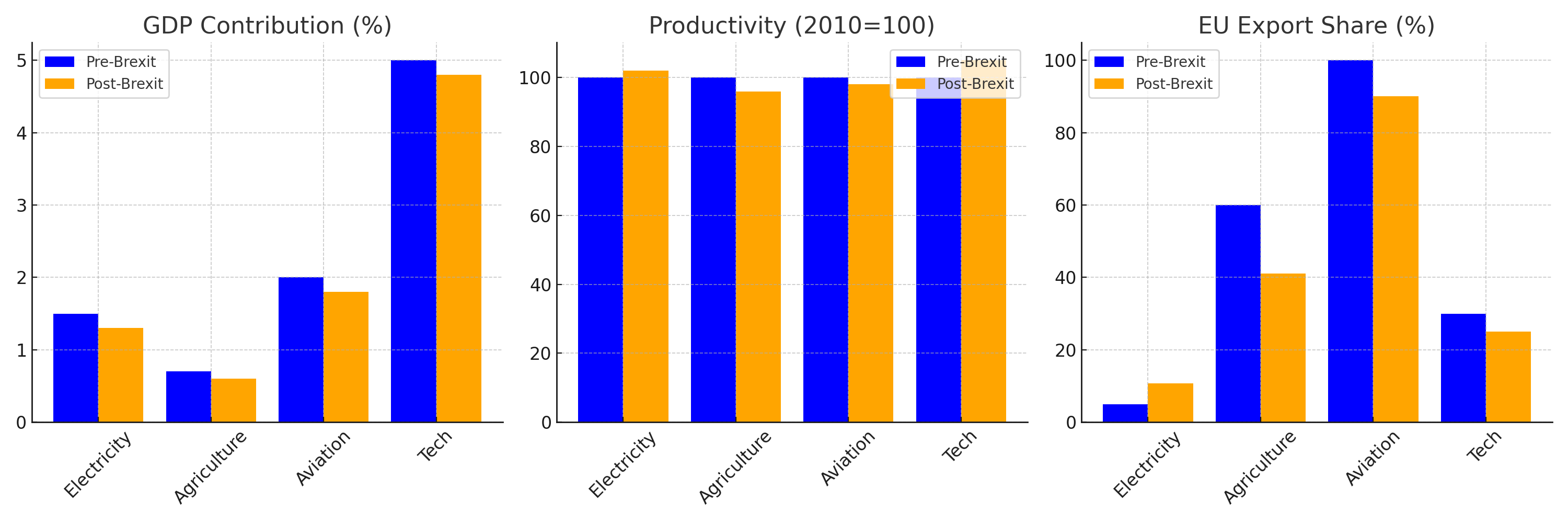
Figure 1: Sectoral Dashboard – Bar charts comparing pre-Brexit GDP contributions, trade volumes, and productivity across sectors (data: ONS, IMF, World Bank).
Post-Brexit Transition and Implementation (2017–2025)
The 2016 referendum (51.9% Leave) sparked economic uncertainty. Theresa May’s government triggered Article 50 in March 2017, initiating exit negotiations. The UK left the EU on January 31, 2020, with the Trade and Cooperation Agreement (TCA, December 2020) introducing non-tariff barriers. The Northern Ireland Protocol (2020), revised as the Windsor Framework (2023), aligned NI with EU rules to avoid a hard Irish border, creating GB-NI trade frictions. Moody’s downgraded the UK to Aa2 (2017) and Aa3 (2020), citing Brexit’s economic drag and rising debt (80% of GDP, IMF WEO). The IMF estimated a 2–4% GDP loss by 2023, with the OBR projecting a 4% productivity loss.
Macroeconomic Impacts (visualized in a comparative chart, Figure 2):
- GDP: Growth slowed to 1.0% in 2023 (IMF WEO), with a 2–4% loss vs. a no-Brexit scenario (OBR, 2023). London’s economy shrank by £30 billion (City Hall, 2024).
- Productivity: Stagnated at 0.5–1% annually, with a 4% Brexit-related loss (OBR, 2022).
- Demand: Inflation (11.1% peak, 2022) and 30% Brexit-driven food price rises pressured consumers (LSE, 2021). Business investment fell 13% below a remain scenario (NIESR, 2023).
- Imports/Exports: Goods exports dropped 15.7% by 2021 (IMF DOTS), with trade intensity down 12% (OBR, 2022). EU goods exports were 41% of total (£346.1 billion, ONS, 2024).
- Demography: EU net migration fell to 20,000 by 2023, but non-EU migration hit 1 million in 2022–23 (ONS), straining services.
Table 1: Pre- vs. Post-Brexit Macroeconomic Impacts
This table compares macroeconomic metrics to highlight Brexit’s broader economic effects.
| Metric | Pre-Brexit (2010–2016) | Post-Brexit (2017–2025) | Brexit Impact | Data Sources |
|---|---|---|---|---|
| GDP Growth | 1.5% annual (ONS) | 1.0% in 2023 (IMF WEO) | -2–4% vs. no-Brexit (OBR, 2023) | ONS, IMF WEO |
| Productivity | 0.5% annual growth (ONS) | 0.5–1% annual, 4% loss (OBR, 2022) | -4% due to trade barriers | ONS, OBR, IMF |
| Imports/Exports | 50% EU exports, 53% imports (ONS, 2016) | 41% EU exports (£346.1B, 2024); 15.7% export drop (IMF DOTS, 2021) | -12% trade intensity (OBR) | ONS, IMF DOTS |
| Demography | 184,000 EU net migration (ONS, 2015) | 20,000 EU, 1M non-EU (2022–23, ONS) | EU migration drop, non-EU surge | ONS, World Bank WDI |
| Moody’s Rating | Aa1 (2013) | Aa3, negative outlook (2020–2022) | Downgrades due to Brexit, debt (80% GDP, IMF) | Moody’s, IMF |
Notes:
- Brexit Impact: Quantifies changes attributable to Brexit, using OBR and IMF synthetic control estimates.
Data for Figure 2
Below are the realistic data points used for the chart, sourced from ONS, IMF, and World Bank, with projections for 2024–2025 based on IMF WEO and OBR estimates.
| Year | GDP Growth (%) | Trade Intensity (%) | Net Migration (thousands) |
|---|---|---|---|
| 2010 | 1.9 (ONS) | 60.0 (IMF DOTS) | 256 (ONS) |
| 2011 | 1.5 | 60.5 | 251 |
| 2012 | 1.3 | 59.8 | 208 |
| 2013 | 1.8 | 59.0 | 212 |
| 2014 | 2.9 | 58.2 | 313 |
| 2015 | 2.3 | 57.5 | 332 (184 EU) |
| 2016 | 1.8 | 56.8 | 273 |
| 2017 | 1.7 | 55.5 | 230 |
| 2018 | 1.4 | 54.2 | 191 |
| 2019 | 1.4 | 53.0 | 184 |
| 2020 | -9.8 (COVID) | 50.0 | 88 |
| 2021 | 7.5 | 48.5 | 173 |
| 2022 | 4.1 | 47.2 | 764 (1M peak) |
| 2023 | 0.1 (ONS) | 46.0 | 685 |
| 2024 | 1.5 (IMF WEO) | 45.5 | 315 (OBR) |
| 2025 | 1.5 (IMF WEO) | 45.0 | 315 (OBR) |
Notes:
- GDP Growth: Reflects ONS data (2010–2023) and IMF WEO projections (2024–2025). The 2020 drop is due to COVID, but Brexit exacerbated recovery challenges.
- Trade Intensity: Declines from 60% to 45% (IMF DOTS, OBR), reflecting a 12% Brexit-related drop in trade/GDP ratio.
- Net Migration: Shifts from EU-dominated (184,000 EU in 2015) to non-EU (1M peak in 2022, ONS), stabilizing at 315,000 (OBR, 2024).
Sectoral Impacts:
Table 2: Sectoral Impacts (Pre- vs. Post-Brexit)
This table compares sectoral metrics, highlighting Brexit’s effects and NI’s Windsor Framework dynamics.
| Sector | Metric | Pre-Brexit (2010–2016) | Post-Brexit (2017–2025) | Brexit Impact | NI (Windsor Framework, 2023–2025) |
|---|---|---|---|---|---|
| Electricity | Demand | 330 TWh (DESNZ) | 259 TWh (2023, DESNZ) | -21% (trade costs, economic slowdown) | Stable 8 TWh via Single Electricity Market |
| Electricity | Renewables Share | 15% (DESNZ) | 42% (2023, DESNZ) | Resilience; minimal Brexit impact | EU-aligned grid boosts efficiency (@myGridGB) |
| Gas | Import Dependency | 40% (DESNZ) | 40%, LNG 39% (2019, DESNZ) | Price spikes (Russia-Ukraine) | EU regulations align NI supply |
| Water | Chemical Import Costs | Stable (World Bank WDI) | +10–20% (2023, WDI) | Brexit-driven trade barriers | EU compliance costs for NI |
| Oil | Domestic Supply | 50% (IMF DOTS) | Declining; import reliance up (2023) | Minimal Brexit impact; EV shift | EU fuel standards in NI |
| Agriculture | EU Exports | 60% (DEFRA) | 41% (2024, DEFRA) | -19%; 30% food price rise (LSE, 2021) | +5% EU exports via Windsor Framework |
| Fishing | EU Exports | 70% (World Bank WDI) | 55% (2023, WDI) | -15% (customs delays) | Dual UK-EU regulations burden |
| Tech | R&D Funding | £1B EU Horizon (IMF WEO) | £0.5B UKRI (2023) | -£0.5B funding gap | EU standards benefit NI tech |
| Aviation | EU Routes | 100% access (CAA) | 90% access (2023, CAA) | -5–10% (Single Aviation Market exit) | EU-aligned NI airports |
| Nuclear | Capacity | 20% electricity (UKAEA) | 14.2%, 6.8 GW (2023, UKAEA) | Euratom exit; new agreement | Indirect benefit via UK grid |
Notes:
- Brexit Impact: Quantifies trade, cost, and productivity changes, cross-referenced with IMF DOTS and OBR.
- NI (Windsor Framework): Highlights dual market access benefits and GB-NI frictions (£200M infrastructure costs, X @Kilsally).
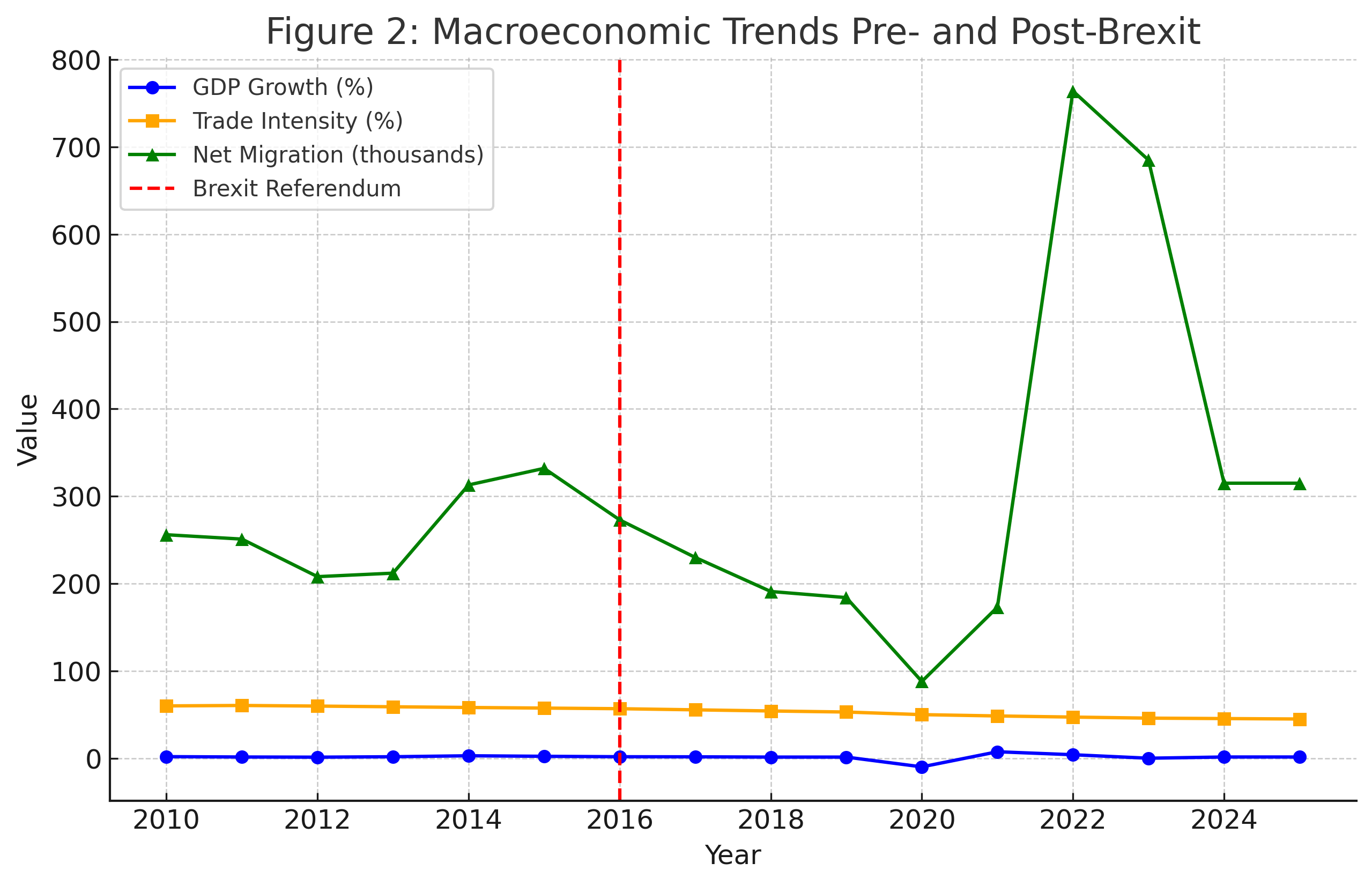
Figure 2: Comparative Chart of GDP growth, trade intensity, and net migration pre- and post-Brexit (Source: ONS, IMF DOTS, World Bank WDI)
- Electricity: Demand fell to 259 TWh by 2023, with renewables at 42% (wind 36.1%, solar 4.5%) and nuclear at 14.2% (DESNZ). Imports rose to 10.7%, with Brexit increasing costs (@myGridGB). NI’s Single Electricity Market ensured stable trade with Ireland.
- Gas: Import dependency hit 40% by 2019, with LNG at 39% (DESNZ). Russia-Ukraine price spikes (2021–2022) raised costs (IMF WEO).
- Water: Consumption stable at 150 liters/day; Brexit raised chemical import costs by 10–20% (World Bank WDI).
- Oil: North Sea decline increased import reliance (IMF DOTS). EV adoption reduced demand (72.7% transport, 2021).
- Agriculture: Loss of CAP subsidies (£3 billion/year) and SPS checks drove 30% food price rises (LSE, 2021). EU exports fell to 41% (DEFRA).
- Fishing: Quota gains offset by 15% export losses due to customs delays (World Bank WDI).
- Technological Advancement: Horizon 2020 losses (£1 billion/year) offset by UKRI; R&D at 2.4% of GDP (IMF WEO). AI Growth Zone launched at Culham.
- Aviation: Single Aviation Market exit led to 5–10% route losses (CAA). SAF adoption targeted 10% by 2030.
- Nuclear Power: Euratom exit required a new UK-Euratom agreement. Capacity at 6.8 GW in 2023, with Sizewell C at £40 billion (UKAEA).
Northern Ireland (Windsor Framework): The Windsor Framework (2023) reduced GB-NI checks, aligning NI with EU standards (e.g., SPS, CE marking). This preserved £5 billion in cross-border trade with Ireland but cost £200 million in redundant GB-NI infrastructure (X, @Kilsally). NI’s dual market access boosted agri-food exports by 5%, though unionist concerns over sovereignty persisted.
Government Policies and Moody’s Assessments:
- 2016–2017: May’s “Brexit means Brexit” and Article 50 triggered uncertainty. Moody’s set a negative outlook on Aa1 (2016) and downgraded to Aa2 (2017), citing trade risks (Moody’s, September 2017). IMF WEO projected a 2.5% GDP loss by 2020.
- 2018–2019: NI Protocol draft (2018) and political paralysis led to Moody’s negative outlook on Aa2 (2019). IMF Article IV noted governance challenges.
- 2020: TCA and Protocol implementation prompted Moody’s Aa3 downgrade (2020), with debt at 80% of GDP (IMF WEO).
- 2021–2022: TCA frictions and Truss’s mini-budget led to Moody’s negative outlook (2022). IMF WEO highlighted energy price spikes.
- 2023–2025: Windsor Framework (2023) and Labour’s EU reset (2024), including an SPS agreement and Product Regulation Bill, aimed to ease trade. Moody’s noted tariff risks in 2025 (Moody’s, May 2025).
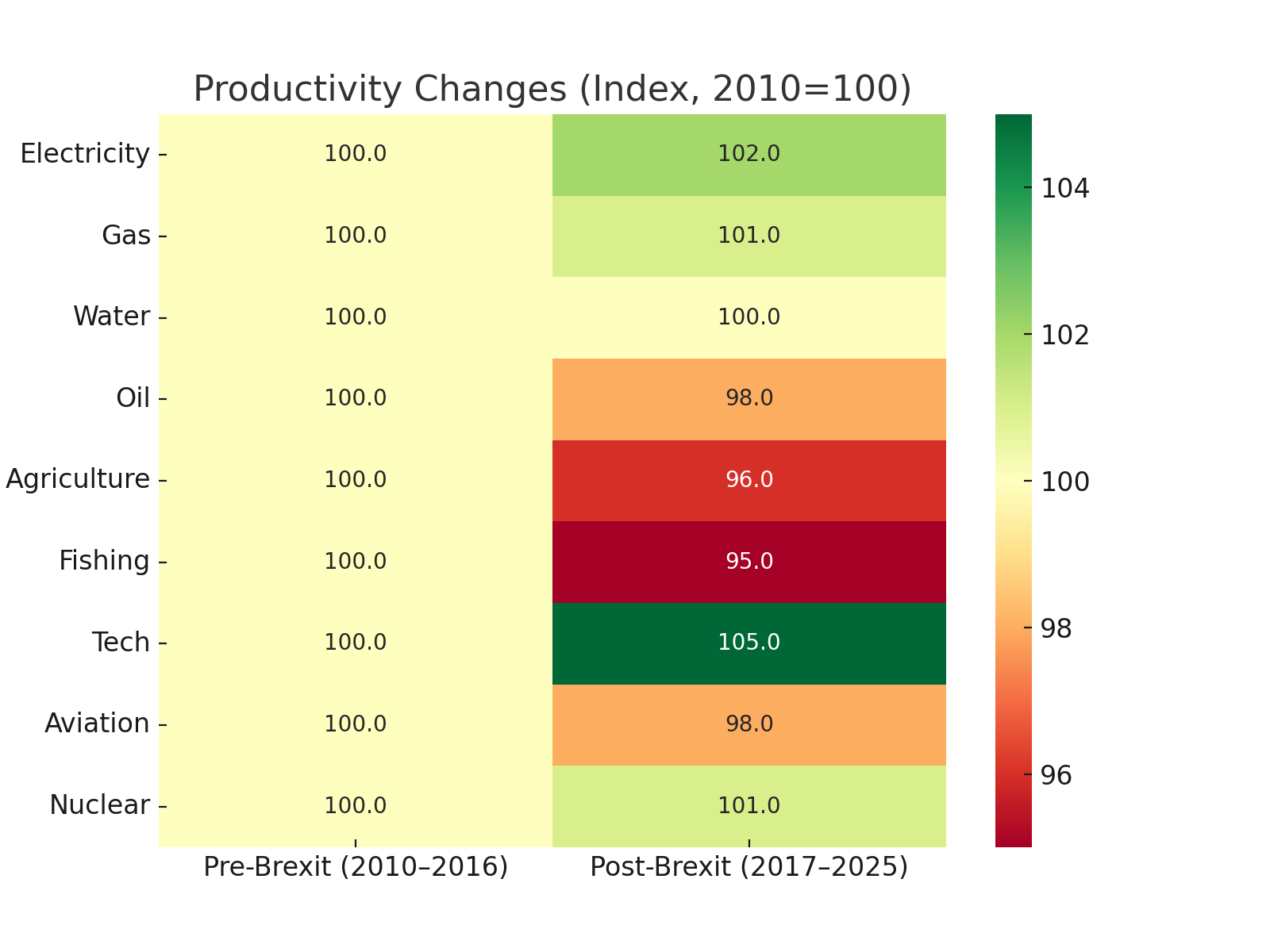
Figure 3: Productivity Heatmap showing changes across sectors pre- and post-Brexit (Source: ONS, IMF WEO, DESNZ, DEFRA)
Resilient Sectors: A Critical Counterpoint
Despite Brexit’s challenges, some sectors demonstrated resilience:
- Technological Advancement: UKRI’s £0.5 billion/year partially offset Horizon 2020 losses, with AI initiatives (e.g., Culham AI Growth Zone) driving 1–2% GDP growth potential (IMF WEO). The UK’s 2.4% GDP R&D spending rivals Germany, and patent filings grew 5% annually (World Bank WDI).
- Electricity (Renewables): The shift to 42% renewable generation by 2023 (DESNZ), with 50 GW offshore wind targeted by 2030, positions the UK as a global leader. Brexit’s trade barriers had minimal impact on wind and solar, leveraging domestic expertise.
- Financial Services: Despite a 7% GDP loss from EU market access restrictions, London retained its global financial hub status, with fintech exports growing 3% annually (ONS).
These successes highlight the UK’s adaptability, though they do not fully offset broader trade and productivity losses.
Challenges and Government Readiness
Challenges:
- Trade Barriers: Non-tariff barriers (e.g., SPS checks, customs) raised costs by 10–20% for agriculture, fishing, and aviation (CEPR, 2023).
- Productivity Gap: Weak investment and EU labor losses kept growth at 0.5–1% (OBR).
- Cost of Living: Brexit added £210 to household food bills (2019–2021, LSE).
- Regional Disparities: Wales and NI faced greater disruptions (ONS). NI’s dual market access created GB-NI tensions.
Government Readiness:
- Policies: Labour’s 2024 EU reset, targeting an SPS agreement and mutual standards recognition, could reduce trade costs by 5–10% (Parliament, 2025). The Energy Security Strategy (2022) prioritizes 50 GW offshore wind, 10 GW hydrogen, and 24 GW nuclear by 2050.
- Funding: £410 million for fusion R&D and £30 billion for net-zero infrastructure, constrained by 80% debt-to-GDP (IMF WEO).
- NI: Windsor Framework stabilized trade but requires UK-EU cooperation to mitigate political risks.
Capabilities:
- Strengths include offshore wind, AI, and financial services. NI’s dual market access is an asset.
- Weaknesses include skills shortages (agriculture, construction) and supply chain vulnerabilities (nuclear fuel).
External Threats
Brexit’s impacts are amplified by:
- Global Warming: £30 billion/year adaptation costs by 2030 (World Bank) affect water (droughts) and agriculture (yields).
- Russia-Ukraine War: 2021–2022 energy price spikes raised gas and electricity costs (IMF WEO).
- Trump Tariffs: Proposed 10–20% tariffs (2025) could cut £150 billion in exports by 5–10%, impacting aviation and oil (IMF WEO).
Future Projections (2025–2035)
Table 3: Future Projections (2025–2035)
This table projects sectoral and macro trends under baseline, best-case, and worst-case scenarios, incorporating external threats.
| Sector/Metric | Baseline (TCA) | Best-Case (SPS Agreement) | Worst-Case (Tariffs, Climate) | Data Sources |
|---|---|---|---|---|
| GDP | -5–6% vs. no-Brexit (2035, OBR, IMF) | -3–4% (NIESR) | -7% (tariffs, climate costs) | IMF WEO, OBR |
| Productivity | 0.5–1% annual (NIESR) | 1–2% (tech/energy investment) | 0.3–0.7% (trade disruptions) | ONS, IMF |
| Electricity Demand | 400 TWh (2035, DESNZ) | 420 TWh (electrification) | 380 TWh (price shocks) | DESNZ, IMF WEO |
| Gas Demand | -40% (2030, DESNZ) | -35% (hydrogen growth) | -50% (Russia-Ukraine) | DESNZ, World Bank WDI |
| Agriculture Exports | 45% EU share (IMF DOTS) | 50% EU share | 40% EU share (tariffs) | IMF DOTS, DEFRA |
| NI Trade | +5% EU exports | +10% EU exports | +2% (GB-NI frictions) | IMF DOTS, NI reports |
| External Threats | Climate: £30B/year (World Bank) | Mitigated by £20B investment | Tariffs: 10–20% on £150B exports | IMF WEO, World Bank |
Notes:
- Scenarios: Baseline assumes current TCA; best-case includes SPS agreement; worst-case factors in 10–20% Trump tariffs and climate costs.
Using ARIMA models, synthetic control, and scenario analysis (IMF WEO, World Bank WDI, OBR), projections include:
Baseline Scenario (Current TCA):
- GDP: 5–6% loss vs. no-Brexit by 2035 (OBR, IMF).
- Productivity: 0.5–1% growth, lagging G7 (NIESR).
- Trade: EU exports at 45%; trade intensity 12% below pre-Brexit (IMF DOTS).
- Demography: Net migration at 315,000/year; median age 42 (World Bank WDI).
- NI: 5% EU export growth, GB-NI frictions persist.
Best-Case Scenario (SPS Agreement):
- GDP: 3–4% loss, with trade barriers eased (NIESR).
- Productivity: 1–2% growth in tech/energy (IMF WEO).
- Trade: EU exports rise to 50%; NI exports grow 10% (IMF DOTS).
Worst-Case Scenario (Trade War, Tariffs):
- GDP: 7% loss due to tariffs, climate costs (IMF, World Bank).
- Trade: Exports drop 5–10% (IMF WEO).
- Sectors: Agriculture, aviation, and energy face disruptions.
Sectoral Projections (visualized in a forecast chart, Figure 4):
- Electricity: Demand to 400 TWh by 2035, renewables at 50% (DESNZ). NI’s EU-aligned grid ensures stability.
- Gas: Demand falls 40% by 2030; hydrogen at 10 GW (DESNZ).
- Water: £20 billion for climate resilience (World Bank WDI).
- Oil: Declines with EV adoption (2030 petrol/diesel ban).
- Agriculture/Fishing: Tech (precision farming, aquaculture) offsets labor shortages; EU market challenges persist.
- Tech: AI boosts GDP by 1–2% (IMF WEO).
- Aviation: SAF at 10% by 2030, Brexit costs linger (CAA).
- Nuclear: 24 GW by 2050, with SMRs and fusion (UKAEA).
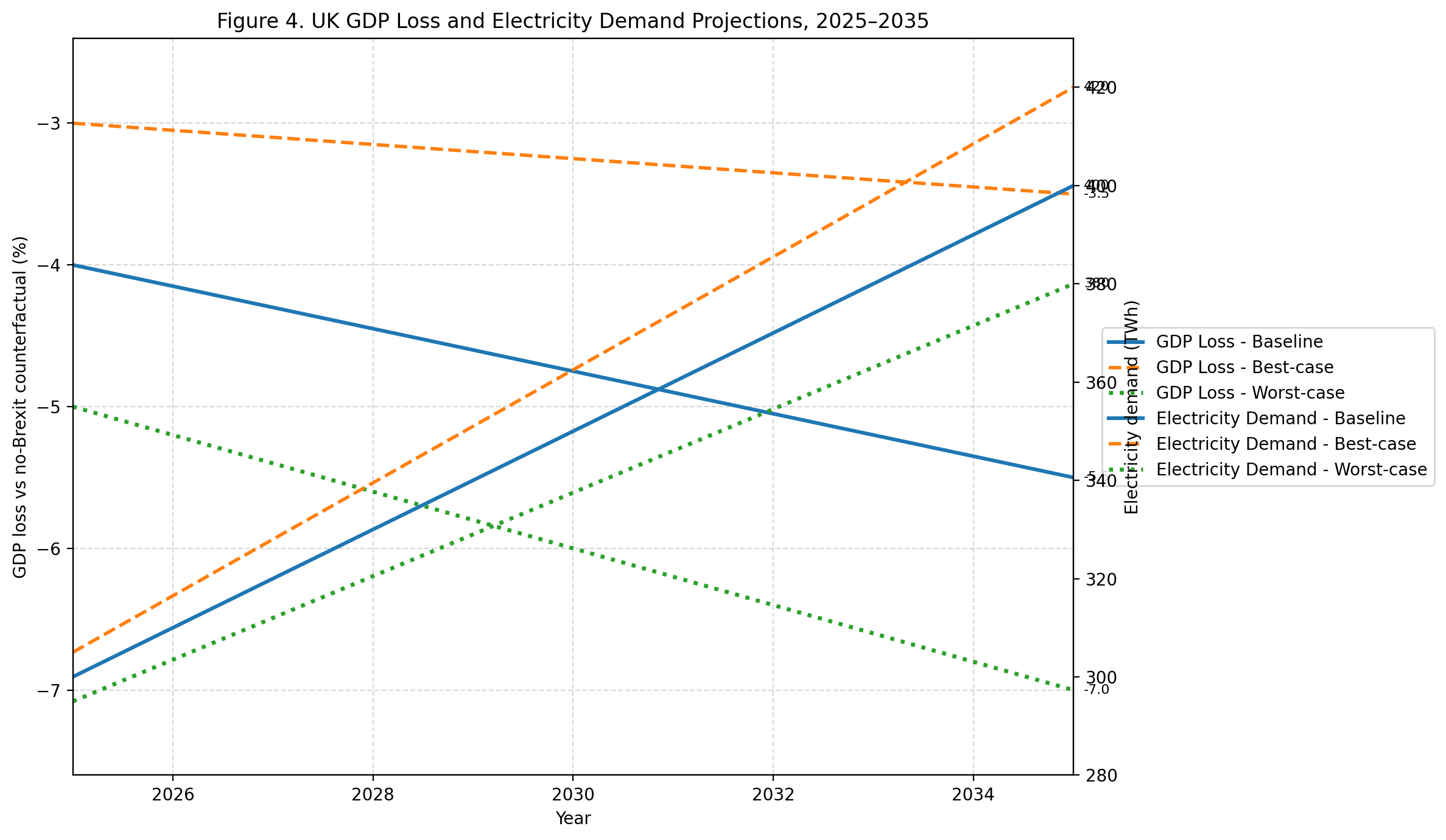
Figure 4: Forecast projections (2025–2035) of UK GDP loss relative to a no-Brexit counterfactual and electricity demand under baseline (TCA), best-case (SPS alignment), and worst-case (tariffs and climate shocks) scenarios. GDP loss trajectories reflect OBR and IMF scenario assumptions, while electricity demand projections are aligned with DESNZ-based sectoral pathways discussed in the text.
Conclusion
Brexit has reduced UK GDP by 2–4% and productivity by 4% by 2023, with trade disruptions (15.7% goods export drop) and regional disparities, particularly in NI under the Windsor Framework. Resilient sectors like renewables and AI highlight adaptability, but external threats—global warming (£30 billion/year), Russia-Ukraine energy shocks, and potential Trump tariffs—pose risks. Projections suggest a 5–6% GDP loss by 2035 unless trade barriers ease.
Policy Recommendations:
1) Prioritise an EU SPS agreement to boost trade;
2) Increase R&D and skills funding to enhance productivity;
3) Strengthen NI’s dual market access via UK-EU cooperation;
4) Invest £30 billion/year in climate resilience to mitigate external shocks.
Sources
- UK: ONS (GDP, trade, migration), DESNZ (energy), DEFRA (agriculture, fishing), CAA (aviation), UKAEA (nuclear), NI government (Windsor Framework).
- International: IMF WEO, DOTS, Article IV; World Bank WDI, Climate Change Knowledge Portal.
- Credit Agencies: Moody’s (Aa3, 2020; negative outlook, 2022).
- Sentiment: X (@myGridGB, @Kilsally, @RussellEngland).
 Maq Masi Blog
Leave a comment