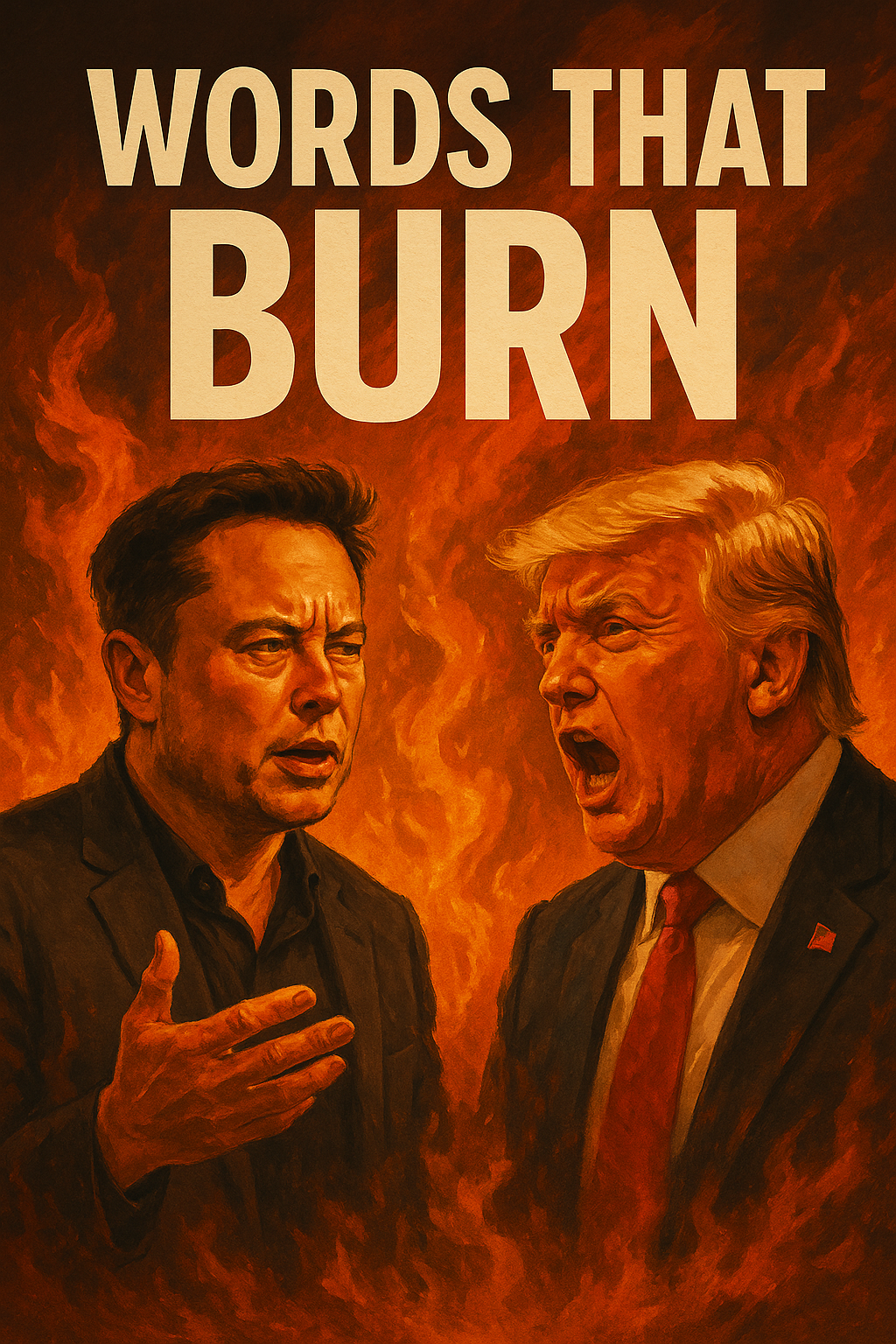
How do powerful men speak when their power begins to slip? How does the tone shift when they realise influence is no longer control — and performance no longer persuasion? I’ve been observing the public rhetoric of Elon Musk and Donald Trump across recent months, and what I’ve seen is not confidence. It is confusion. It is contradiction. And at times, it is cruelty dressed up as command.
After Trump’s second-term victory, Musk appeared euphoric. Reports and videos emerged of him using gestures disturbingly close to fascist imagery — a Nazi-style salute, whether ironic or not, is not forgettable. His rhetoric ignited far-right sentiment, not only in the U.S. but in the UK, where his platform became a playground for extremists. Then, he travelled to Germany, publicly siding with the far-right AfD — a party under surveillance for anti-democratic activity. This was not a tech entrepreneur speaking about freedom. This was a billionaire meddling in the fabric of sovereign democracies.
Then came the fallout. Musk, after being ousted from an informal advisory role, escalated his attacks on Trump with personal accusations, including references to Trump’s alleged links to the Epstein files — posts he later deleted. The tone was not immediately subdued; it was confrontational and sharp. Only after facing public backlash and market consequences did Musk retreat to the language of business and productivity, shifting his rhetoric away from political hostility toward corporate focus. He appeared to be stepping back — not from principle, but from the public fallout of a mess he had helped inflame.
Trump’s shift is even more revealing. He once boasted he could settle the Russia-Ukraine war “in 24 hours.” He made bold declarations, crafted with populist flair and no roadmap. But peace did not follow. As the war dragged on, Trump’s tone turned bitter — attacking Zelensky for being ungrateful, suggesting Putin was harder to handle than expected. Frustration crept in where certainty once roared.
In this fog of failure, Trump reached backward to reclaim relevance. He claimed he had “stopped India and Pakistan from going to war.” There’s no public evidence of such a feat — but self-glorification doesn’t require facts, just repetition. And then came Iran.
Following Israel’s airstrikes on Iranian infrastructure, Trump did not express restraint or concern. He posted a grotesquely worded rant on Truth Social, celebrating death with phrases like “they are all DEAD now,” “great death and destruction,” and “slaughter.” It wasn’t diplomacy. It wasn’t deterrence. It was theatre — the kind performed by those who have no control over what’s actually happening on the stage.
What kind of leader uses human casualties as rhetorical currency? What kind of statesman treats war as a personal drama, where each missile validates a talking point?
The truth is: Trump failed to bring Iran to the negotiating table. His approach to diplomacy was not dialogue, but domination. “Just do it,” he said — as if nations operate like subordinates in a corporate merger. But this isn’t The Apprentice. When Iran retaliated, Trump’s inner circle scrambled to soften the tone. Marco Rubio quickly distanced the U.S. from the conflict, saying “we are not involved.” Others followed suit. But Trump had said too much. His words, shared by his vice president and amplified by his team, could not be unsaid. There was no narrative left to pivot to.
This is what empires do when their reach exceeds their grasp. They double down on image, inflate minor gestures into historic claims, and treat diplomacy as performance art. But the world is changing. Nations like Iran and others in the Global South are no longer simply reactive. They understand the game — and increasingly, they refuse to play it.
The shift in tone from both Trump and Musk reflects something deeper than personal ego. It’s the sound of strategic fatigue. When dominance slips, language becomes louder. When power weakens, the words become crueler, more desperate, and ultimately, less coherent.
And yet, the public remains dangerously enchanted by these narratives. Because they are repeated. Because they’re simple. Because they’re sold with confidence. But confidence, as I’ve argued before, is often just fear with a mask on.
We must learn to listen not just to what is said, but to the panic underneath. And let it be clear: this critique does not excuse or endorse the oppressive actions of the Iranian regime. Autocracy in any form must be held accountable. But condemning one does not blind us to the reckless language and imperial denial of another. When Trump celebrates slaughter, it’s not power he’s showing — it’s the loss of power. When Musk drops nationalism for neutral business-speak, it’s not strategy — it’s damage control.
We are not just witnessing the failure of individuals. We are witnessing the rhetorical collapse of an imperial mindset.
And if we don’t challenge it now, we will find ourselves complicit not just in the destruction of truth, but in the normalisation of brutality.

 Maq Masi Blog
Leave a comment