
– Maq Masi
You pour a cup of tea. Steam rises. Somewhere, quietly, something is shifting. Not a riot. Not a declaration. Just a whisper: “Form is emptiness; emptiness is form.” It sounds cryptic. Perhaps poetic. Or even absurd. How could such words—so weightless—change the weight of history?
Yet, they already have.
In my youth, I believed liberation came through struggle. Marx explained the mechanics: identify the oppressor, seize control, and restructure the world. The logic felt righteous. But years later, I found myself in quiet monasteries of Kyoto, where monks spoke not of chains forged by others, but of chains forged by the mind itself. “Shatter the illusion,” they said, “and the world follows.”
I resisted. If you’re hungry, can “awakening” feed you? If you’re exploited, do you meditate on your boss’s emptiness? These questions haunted me—until I discovered a different kind of protest.
In the Polish archives, I met Lech Wałęsa—not in person, but through the echoes of the Solidarity movement. Shipyard workers stood against tanks with no slogans of hate. They hung images of the Virgin Mary on cranes. They held silence, not weapons. Their message was simple: “We are human. You are human. This system is not.” When Wałęsa faced down communist generals, he didn’t come for revenge. He came with dialogue. And the Berlin Wall didn’t crash—it crumbled beneath music, laughter, and a generation refusing to keep fighting shadows. A Zen master might have smiled: “Stop fighting ghosts, and the battlefield disappears.”
After Hiroshima’s devastation, Japan faced a choice. Some turned to Marxism, to strikes and class struggle. But Zen turned inward and quietly outward. D.T. Suzuki wrote essays to the West, and Matsushita—the man who founded Panasonic—told his workers: “This factory is a place of meditation. You are not cogs. You are Buddhas assembling transistors.” Strange words. But somehow, they rebuilt not just an economy, but a philosophy of work: mushin—effort without ego. Wabi-sabi—the beauty of imperfection. The revolution was not televised; it was felt in every meticulous act.
Even Silicon Valley bore witness. Steve Jobs didn’t go to the Zen Centre for profit margins. He went seeking silence. He asked, “How do you make technology disappear?” The iPhone wasn’t just a phone. It was mu—emptiness, presence, simplicity—pressed into glass. A tool that held everything by appearing to be nothing. With it, movements in Cairo and Kyiv were born. Tyrants feared not guns, but networks. Marx dreamed of workers owning machines. Jobs made machines that felt like air—and gave them to the people.
Does this mean protest is obsolete? Far from it. Thich Nhat Hanh, a Vietnamese monk, saw bombs fall and built villages. He taught: “The pilot is not evil. He is a leaf blown by the wind of ignorance.” Then he organised—not with anger, but with loving-kindness. When U.S. senators sought his wisdom, he didn’t rage. He served tea and said, “Breathe. See the emptiness of ‘enemy.’” Years later, his followers stood in front of logging companies with no violence—just apple juice and compassion: “Brother, let’s talk about trees.”
This is the truth Marx missed: Systems are made of minds. And minds can be transformed. A hammer may destroy a statue, but water carves the canyon. Zen is that water—soft, patient, reshaping the stone.
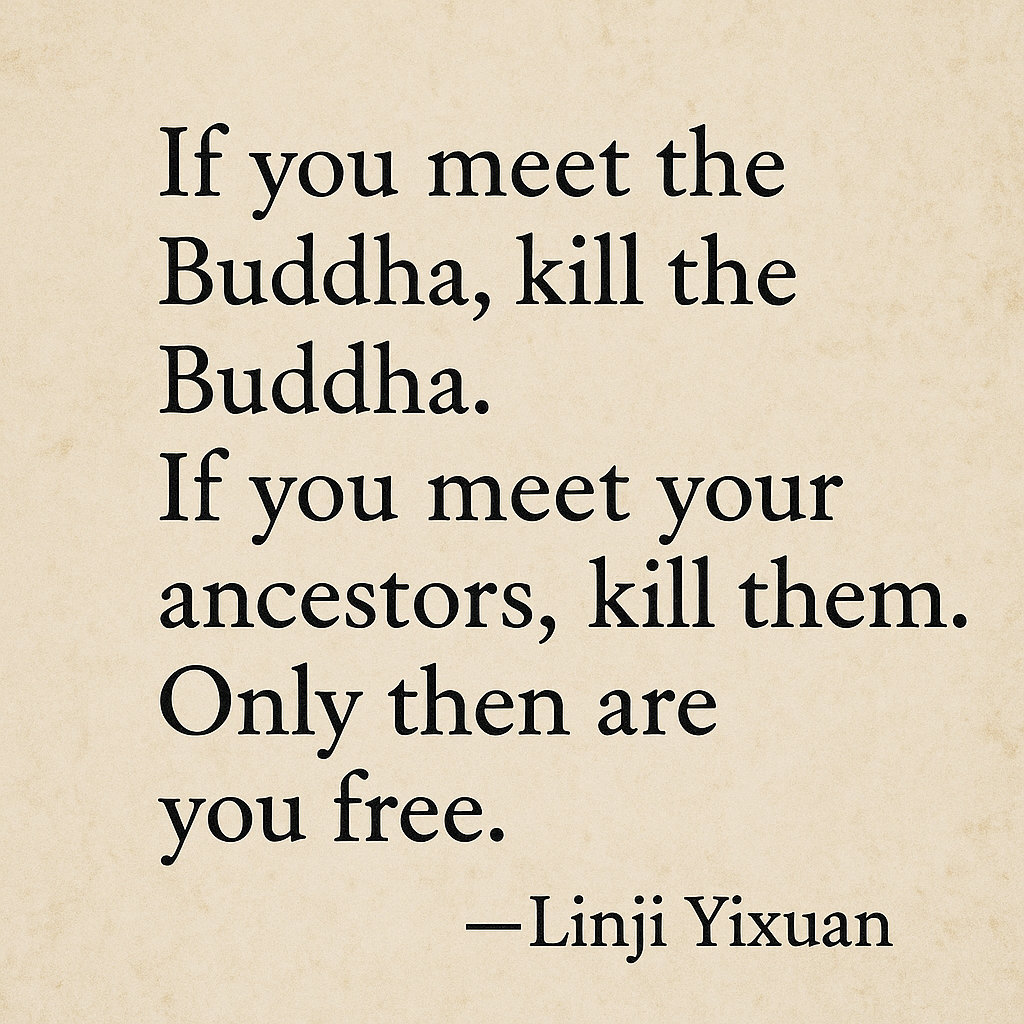
When Zen master Linji said, “Kill the Buddha,” he was not calling for destruction. He meant: Let go of every idea, even sacred ones. Even the idea of liberation itself. If you grip it too tightly, it becomes your new prison. True freedom isn’t taking the palace. It’s realising there was never a palace to begin with. No ruler. No rope. Just the aching, wondrous pulse of being—unadorned, unthreatened, unafraid.
So, yes—march for justice. Organise. Raise your voice. But also ask: Who is the one marching? Trace that self, and you may find something surprising. Not a fixed identity. Not a hero. But wind. Awareness moving through form. Emptiness in motion. That’s where the power lies—not in opposition, but in stillness that acts.
And when you correct your heart-mind, quietly, the world begins to correct itself.
Your tea is cold now. But something is warm, quietly alive. A revolution in the palm of your hand. Nothing to attain. Nothing to fix. Just this breath. Just this cup. Just this moment.
And this, silently, changes everything.
 Maq Masi Blog
Leave a comment