Human history is not only a record of inventions and empires—it is a story of ideas. From the philosophical streets of Athens to the quiet ashrams of India and the riverbanks of ancient China, humanity has long sought meaning not only in how we live, but in why we live as we do. These questions—about virtue, power, balance, justice—have never belonged to a single culture or continent. They are shared inquiries. What differs is how each society responds.
One of the greatest errors of modern thinking is the belief that a single worldview, however compelling, can solve every human problem. It cannot. Life is too layered, conflict too complex, and growth too unpredictable to be governed by one ideology or tradition. Cultures that flourish do so not by clinging to one idea, but by layering many. They survive by absorbing, revising, and integrating. They build from contradiction rather than retreating from it.
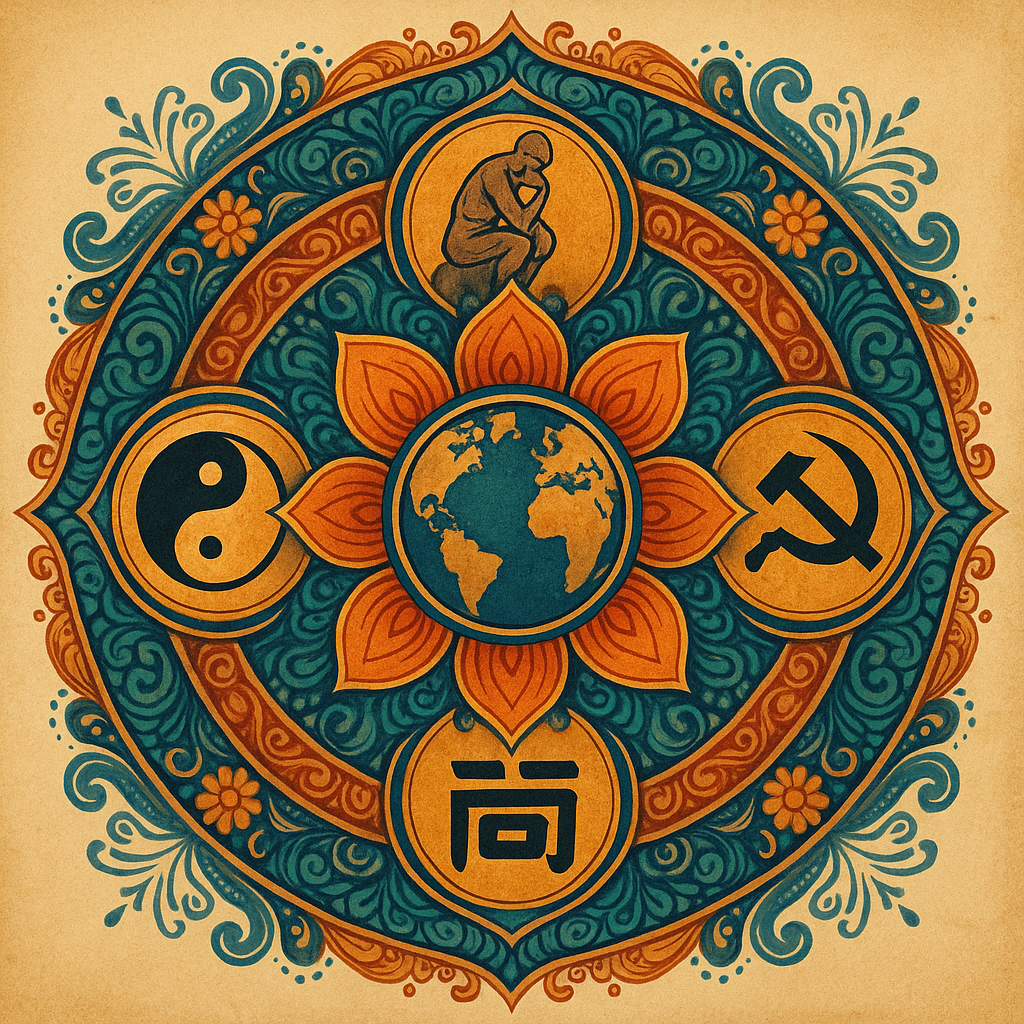
To understand this, consider China—not as an isolated case, but as an example of how cultures evolve through interplay. Chinese civilisation has drawn from multiple streams of thought across millennia, and its thinkers—Confucius, Laozi, Mao Zedong—represent vastly different, sometimes opposing, responses to the same human questions. Yet together, they show that cultural strength comes not from unanimity, but from sustained conversation.
Confucius believed in order, virtue, and relationship. His teachings placed family at the heart of moral development and ritual at the centre of social cohesion. His wisdom doesn’t age because it isn’t abstract; it’s a practical guide to becoming trustworthy, grounded, and useful in community. In times of instability, his philosophy offers direction—not control, but care.
Laozi, writing in a more mystical tone, proposed something different. He questioned structure and praised the soft power of nature. For him, wisdom was not imposed—it was revealed through stillness. His idea of Wu Wei, action without force, invites us to live in rhythm with reality. This isn’t passivity. It is precision. In a culture obsessed with outcomes, Laozi reminds us that peace can be more productive than pressure.
Mao, arriving centuries later, challenged both. He led with rupture. For Mao, thought had to be activated. Oppression had to be named, structures broken, the silenced made visible. While his methods carry grave consequences and moral debates, his intellectual significance lies in making ideology accessible to ordinary people. He turned philosophical vision into political motion.
These three figures—preserver, harmoniser, and disruptor—do not agree. But that is the point. They represent a full arc of societal development: continuity, adaptability, and change. In Confucianism we find the ethics of stability; in Daoism, the logic of flow; in Maoism, the urgency of disruption. Together, they show that no single path suffices. Human life requires different postures for different seasons.
This pattern—of borrowing and blending—is not unique to China. It is the essence of culture itself. The West, too, has drawn from Greco-Roman rationality, Abrahamic morality, Enlightenment liberalism, and now increasingly from Eastern mindfulness and Indigenous ecological thought. The richness of any society is measured not by how pure its ideas are, but by how many voices it can hold.
In the realms of health, governance, business, and education, this multiplicity matters. For example, mental health cannot be solved by therapy alone if community structures are weak. Physical well-being declines not only from disease but from disconnection. Economic growth without ethical grounding leads to collapse. A rigid ideology—whether capitalist, socialist, spiritual or scientific—offers only partial solutions. Cultures that thrive recognise this. They adapt by combining frameworks, testing what fits, and discarding what fails.
The Western world, in particular, often prizes clarity and consistency. But life does not move in straight lines. It spirals, it doubles back, it demands flexibility. Cultural resilience comes from the ability to step out of one’s dominant lens and learn from others—not as charity, but as necessity.
That is the real lesson here. Confucius does not cancel Laozi. Laozi does not negate Mao. Instead, their tension creates texture. This texture is what holds a society together when easy answers dissolve. In a world grappling with climate disruption, economic disparity, mental exhaustion, and political instability, the tools for repair will not come from one corner. They must come from many.
We need the logic of the West and the intuitions of the East. We need the order of law and the spontaneity of nature. We need critique, but also compassion. The age of ideological dominance is over. What lies ahead is the era of cultural intelligence—a capacity not just to tolerate difference, but to work with it.
Culture, after all, is not static. It is not museum-bound. It is a living structure built from conversations across time. It shapes how we love, how we lead, how we learn. And its most enduring architects are those who understand that no idea is complete without the presence of another.
So let us read broadly. Let us listen deeply. And let us remember that progress does not come from perfect ideas—but from the courage to live with many.
No civilisation grows from a single seed. It is in the cross-pollination of ideas—ancient and modern, East and West, disruptive and reflective—that humanity finds its strength, its wisdom, and its way forward.
 Maq Masi Blog
Leave a comment