Imagine, for a moment, that everything you think you know about yourself is an illusion. Not in a scary, existential-crisis kind of way—but in a liberating, life-changing one. This is what the Buddha discovered 2,500 years ago, and his insights still shake the foundations of how we see ourselves today.
Most of us walk through life assuming there’s a solid, unchanging “me” inside—a soul, a self, something permanent that carries our essence from moment to moment, even from life to life. But the Buddha looked deeply and found something astonishing: that permanent “you” doesn’t exist.
Wait—does that mean you’re not real? Of course you’re real. You think, feel, and experience the world. But the Buddha invites us to look closer. What we call “me” is actually a flowing, ever-changing collection of parts: your body (always aging, cells regenerating), your feelings (joy today, sorrow tomorrow), your thoughts (endlessly shifting), and even your awareness itself (which is never the same from one moment to the next).
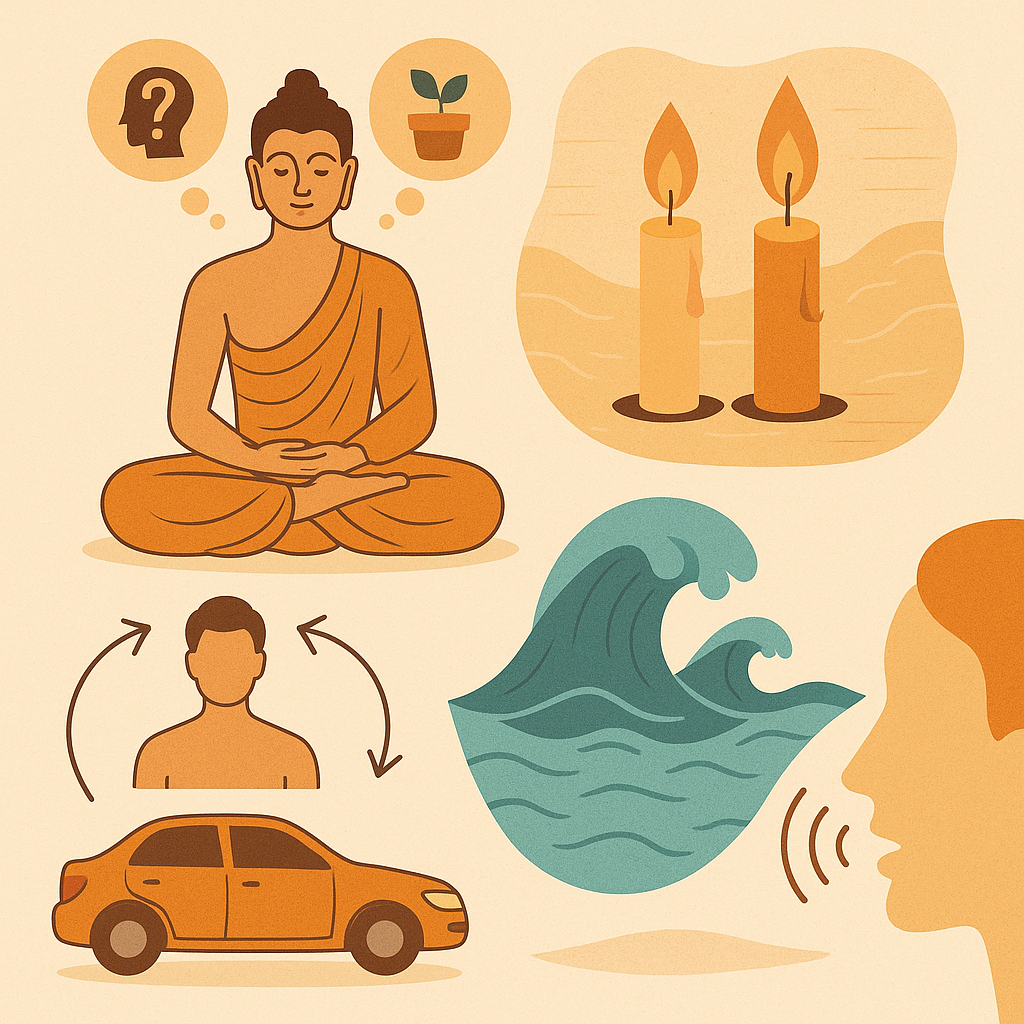
Think of a river. We give it a name—the Mississippi, the Ganges—but is it really the same river from one second to the next? The water is always moving, the banks slowly eroding, the currents shifting. The “river” is just a label we use for this ever-changing process. The Buddha would say the same about you.
So if there’s no fixed self, what keeps this illusion going? Desire. Not just wanting a new car or a better job, but the deeper craving to be someone, to hold onto experiences, to avoid what we fear. This craving is like fuel—it keeps the whole show running, life after life.
Which brings us to karma. Forget what you’ve heard about cosmic reward and punishment. The Buddha’s teaching on karma is more like the law of gravity than a moral scoreboard. Every intentional action—whether a thought, word, or deed—plants a seed. These seeds don’t magically guarantee a specific future, but they shape possibilities, like how an acorn contains the potential for an oak tree, given the right conditions.
What matters most isn’t the action itself, but the intention behind it. A kind word spoken with genuine care carries different energy than the same words said out of obligation. A moment of patience in traffic creates a different ripple than road rage. You’re not being judged—you’re simply experiencing the natural consequences of your own choices.
Now, the big question: If there’s no soul, what gets reborn?
Picture a candle flame lighting another candle. Does the first flame “move” to the second? No—but the heat and light continue. Or think of an echo: your voice creates it, but the echo isn’t “you.” In the same way, the Buddha taught that rebirth isn’t a soul hopping into a new body, but a continuous unfolding of cause and effect. At death, the momentum of your actions, habits, and unresolved cravings shapes what arises next. Not because some deity decides, but because this is how existence works—like waves in an endless ocean, each movement influencing the next.
Why does any of this matter? Because when you see through the illusion of a fixed self, something incredible happens: you stop clinging so tightly. The things that once seemed so personal—insults, failures, even death—start to feel more like passing weather. You realize you’re part of something vast, interconnected, and ever-changing. And most importantly, you see that you have the power to shape what comes next.
The Buddha wasn’t trying to convince you of a philosophy. He was pointing to something you can verify for yourself. Next time a strong emotion arises—anger, fear, even happiness—pause and ask: Is this feeling “me,” or just a passing storm in the mind? Watch how it changes. See how nothing stays.
That’s the beginning of true freedom. Not after death—right here, right now.
 Maq Masi Blog
Leave a comment