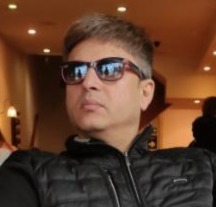
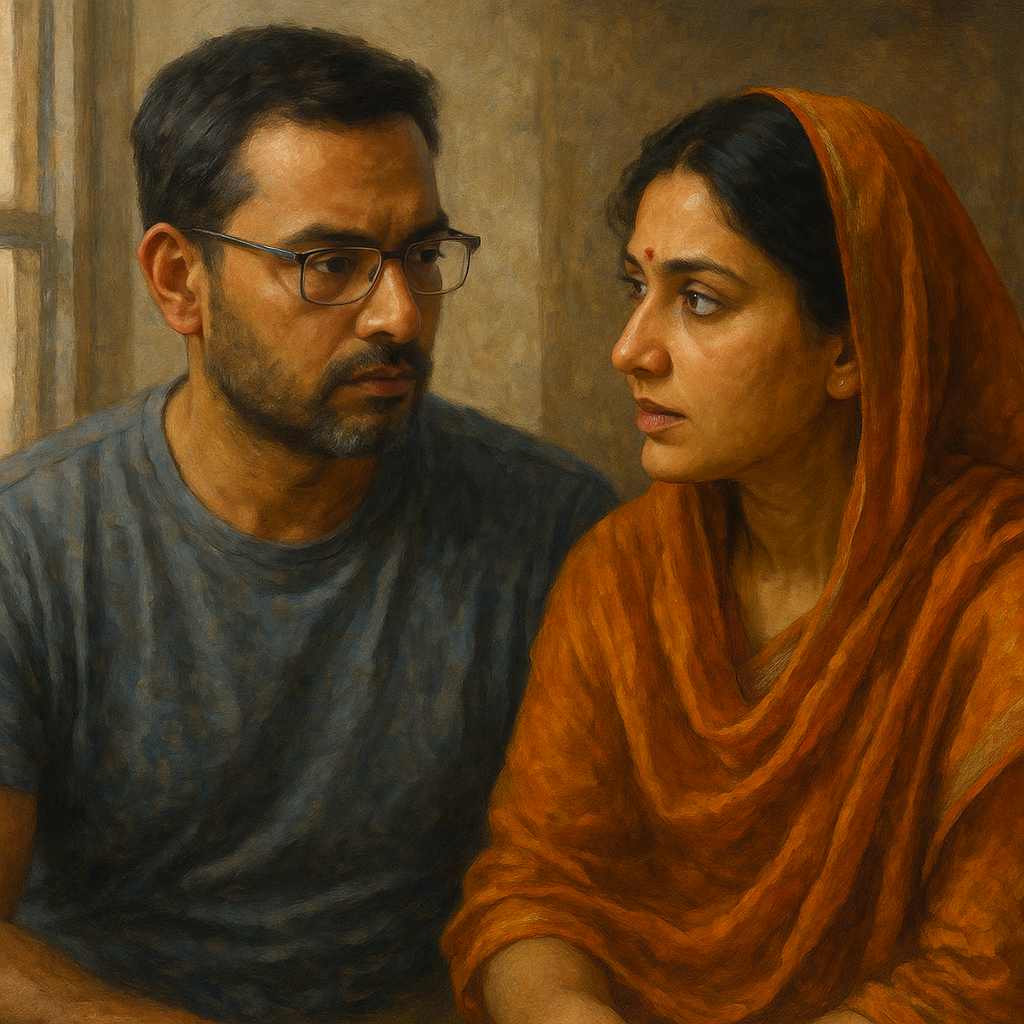
He was a man of code, not creed. Aryan’s world was built on a foundation of verifiable data, a universe where every effect had a traceable cause. For him, belief was not a premise to be accepted, but a conclusion to be earned—the final product of a rigorous audit of the evidence. His philosophy was not found in ancient texts but forged in the silent, stubborn laboratory of lived experience.
She was a woman sculpted by a different truth. Vaishali’s strength was just as real, her logic just as sharp, but it operated within a different framework. Hers was a world infused with the incense of temple prayers, the weight of family tradition, the quiet hum of destiny. She had battled tangible injustices, yet the very air she breathed spoke of unseen forces. “Your soil shapes your soul,” she’d say. You can fight your upbringing, but you can never fully escape its grammar.
When they found each other again after years adrift, their conversations became a gentle, persistent clash of these frameworks.
One night, her voice soft over the phone, she ventured a theory. “Don’t you think it was meant to be? After all this time, for our paths to cross again… what else could it be but destiny?”
Aryan’s response was a calm counter-algorithm. “I think it was persistence. I think it was the cumulative result of a thousand small choices. If you hadn’t messaged, if I hadn’t replied, we’d still be two separate data points. Our past silence wasn’t fate’s design—it was our own. No third party wrote that story. We did.”
The line went quiet. For her, the idea of destiny was a narrative balm; it transformed the chaotic pain of their lost years into a purposeful, preordained journey. For him, that same idea was an elegant evasion, a way to outsource agency and obscure the simple, terrifying truth of their own accountability.
This was the unique architecture of their bond: not a merger into one mind, but a constant, respectful dialogue between two operating systems. She reached for metaphor when logic hit its limit; he demanded a debug log when emotion clouded the output.
Yet, paradoxically, this friction was the very thing that bonded them. In Vaishali’s faith, Aryan found a human warmth his stark equations could never generate. In his relentless skepticism, she found an intellectual integrity that grounded her, a system check that prevented her own heart from glitching into easy answers.
Their love was a living thesis, debated not in academic journals but in the low light of a smartphone screen at 2 a.m. It was a proof argued in the pauses, in the breaths between sentences.
So, which engine drove them? Destiny or will? Is love a state of grace to be accepted, or a verb—a series of actions to be performed?
Perhaps the most compelling answer is that it is the tension itself that defines them. Because love, at its best, doesn’t seek a final answer. It thrives in the fertile, uncertain space between the poetic and the proven, between the pull of the stars and the courage to simply pick up the phone.
And so the question they live with is the one they leave with you: When two stories re-sync after a lifetime of static, is it the invisible hand of a grand narrative?
Or is it the breathtaking, simple power of one person typing, “Hello, it’s me,” and the other choosing to reply?
 Maq Masi Blog
Leave a comment