
Trump’s Second Tenure Through Unapologetic Power Politics
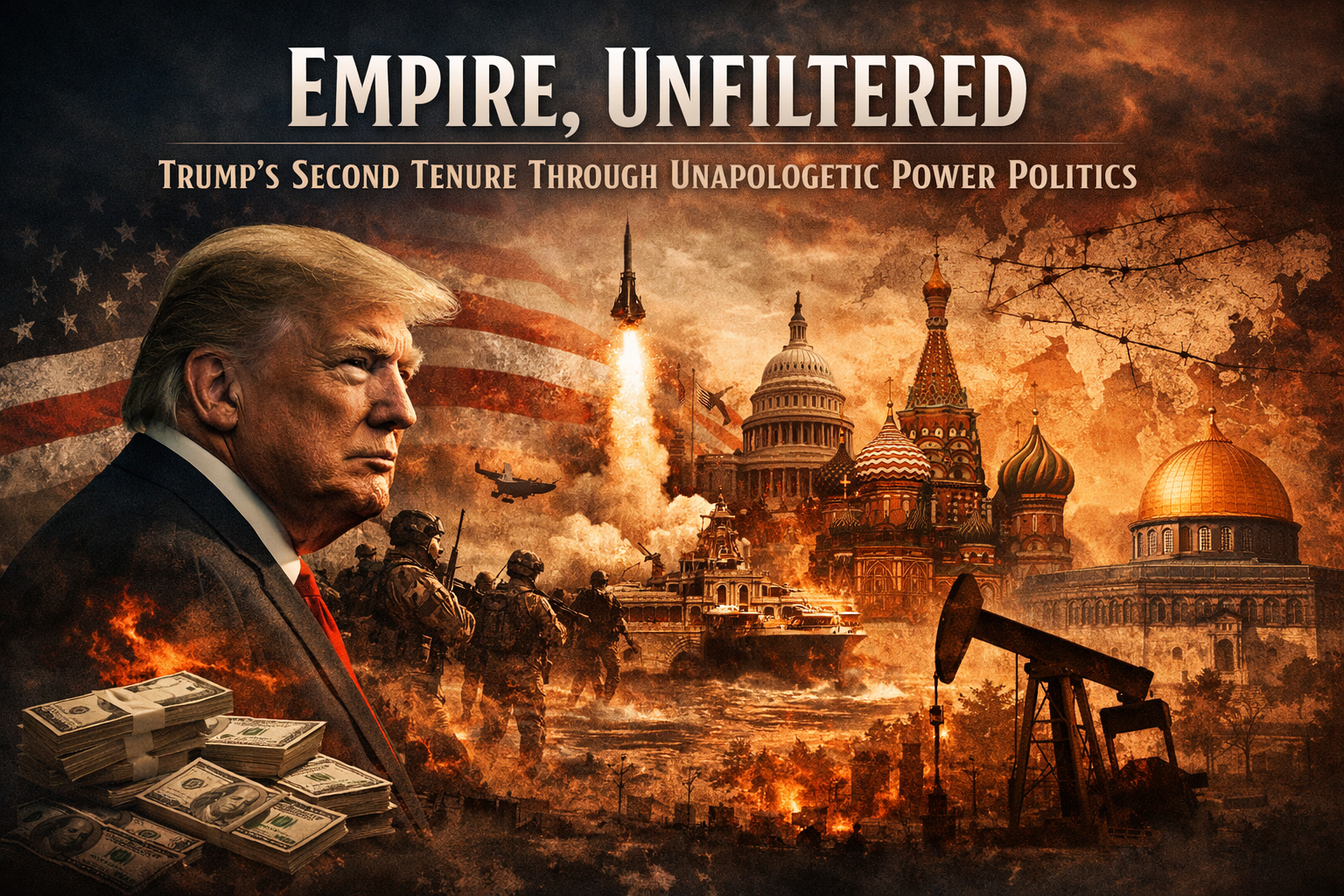
Through a lens of unapologetic power politics, this essay abandons neutrality by design. I have written elsewhere about restraint, ethics, and the human cost of state behaviour. I have argued for balance, legality, and moral responsibility in international relations. This time, I am doing the opposite, openly and deliberately. What follows is written from the vantage point of empire, not conscience. From dominance rather than decency. From the belief that power, once softened by hesitation, is already slipping.
This posture does not emerge from confidence alone. It emerges from a sense that the old order no longer guarantees advantage. Empires speak the language of values when they are secure. They become blunt when they sense erosion: debt, industrial hollowing, demographic pressure, technological diffusion, and the quiet collapse of unquestioned supremacy. Trump’s second tenure reads less like triumph and more like refusal. A refusal to manage decline politely.
The central error critics make is treating his actions as disconnected policies. They are better understood as a governing method: destabilise expectations, then offer order at a price. Predictability breeds comfort. Comfort breeds leverage loss. Trump and his team appear to treat uncertainty itself as a strategic asset. When no one can rely on precedent, every actor is forced back to negotiation from a position of anxiety.
This is why tariffs arrive abruptly, borders harden without cushioning, and threats are issued without diplomatic rehearsal. It is not incoherence. It is instrumental unpredictability. What appears unmanageable from the outside is internally consistent: create enough uncertainty that no actor can settle into opposition without cost.
Ukraine exposed this logic most starkly. The withdrawal of intelligence sharing and the hollowing out of information support was read globally as favouring Russia. Lives were endangered. Alliances were shaken. Yet, in the same breath, sanctions remained in place, and pressure intensified on energy flows. This is not loyalty or betrayal. It is leverage applied from multiple directions. Ukraine is squeezed to accept terms. Russia is constrained without being provoked into uncontrollable escalation. Even third parties, including major buyers of discounted Russian crude, find themselves disciplined. In this worldview, no actor is entitled to moral consistency. Only outcomes matter.
The dismantling of international broadcasting followed the same logic. Where previous administrations invested in narrative, persuasion, and soft power, Trump’s camp appears to have concluded that these instruments are slow, compromised, and internally captured. Influence through explanation is abandoned in favour of influence through fear, scarcity, and direct pressure. The sermon is dropped. The ultimatum remains.
Then came Maduro. The capture of a sitting head of state sent shockwaves through diplomatic circles and security councils alike. Supporters call it decisive deterrence. Critics call it lawlessness. From this lens, it is neither mistake nor overreach. It is imperial memory being refreshed. A reminder that certain powers can still reach into a capital and remove a leader if the cost-benefit calculation permits it. Law is not denied here. It is subordinated.
The Gulf engagements make sense only when stripped of sentiment. Saudi Arabia and Qatar are not courted as partners in shared values, but as nodes of capital, energy control, and regional leverage. Pressure does not always arrive as threat. Sometimes it arrives as exposure. Allow instability elsewhere, permit escalation by allies, then offer protection and restraint in exchange for investment, alignment, and obedience. Trillions pledged are not gestures of friendship. They are insurance premiums.
North Korea was treated similarly. Meeting its leader shattered decades of diplomatic theatre. Critics saw legitimisation. Trump saw personalisation. Institutions fear recognition because it dissolves moral leverage. Trump abandoned moral leverage entirely and replaced it with spectacle and direct bargaining. Enemies are easier to manage when stripped of abstraction.
His approach to Russia followed the same logic. Accommodation was never admiration. It was acceptance of reality. Powers exist whether approved or not. Trump treated rivals as rivals, not as delinquents awaiting correction. To those invested in moral hierarchies, this looked like betrayal. To those invested in outcomes, it looked like realism without ceremony.
Europe was not spared. Pressure to raise defence spending was not abandonment but recalibration. Security was no longer subsidised. Protection was no longer charitable. The outrage that followed merely confirmed the diagnosis: dependency had been mistaken for unity.
On climate, the divergence is deliberate. While others speak of net zero as a moral horizon, Trump moved in the opposite direction. Energy dominance was prioritised over climate consensus. In this lens, environmental restraint is a luxury only affordable if rivals restrain themselves equally. Anything else is self-imposed weakness. Climate becomes a tool, not a creed.
Even allies were not immune. Billionaires, donors, industrial champions. None were protected classes. Those who helped him rise were dispensable once they complicated the programme. Loyalty flows upwards, not sideways. In an imperial operating system, individuals are instruments, not partners.
Then there are the threats that sound absurd until they are understood properly: Panama, Canada, Greenland, renamed seas. Are these real ambitions or theatre? In this style of governance, the threat is already the act. You do not need to annex. You need the other side to believe you might. Anxiety becomes the negotiating currency. Concessions arrive quietly once the imagination is unsettled.
This is not governance designed to be admired. It is governance designed to be obeyed. It is not about managing the world. It is about making the world manageable again by frightening it into alignment.
This essay is not a defence of justice, nor an endorsement of morality abandoned. It is an interpretation of power when it stops explaining itself. Whether this approach restores dominance or accelerates collapse is unknowable. What is certain is this: it marks the moment when empire no longer seeks consent, no longer performs virtue, and no longer pretends its ambitions are benevolent. It simply issues terms.
 Maq Masi Blog
Leave a comment