
Introduction: Bosnia and Herzegovina at a Glance
Bosnia and Herzegovina, located in Southeast Europe on the Balkan Peninsula, covers roughly 51,000 square kilometers and is home to about 3.3 million people. It is a country of rich ethnic and religious diversity, predominantly inhabited by three Slavic groups: Bosniaks, Croats, and Serbs. These groups correspond closely to three major religions—Sunni Islam for Bosniaks, Roman Catholicism for Croats, and Eastern Orthodoxy for Serbs.
The country is politically divided into two main entities: the Federation of Bosnia and Herzegovina, primarily Bosniak and Croat, and Republika Srpska, predominantly Serb. Additionally, the Brčko District operates as a self-governing administrative unit under state sovereignty.
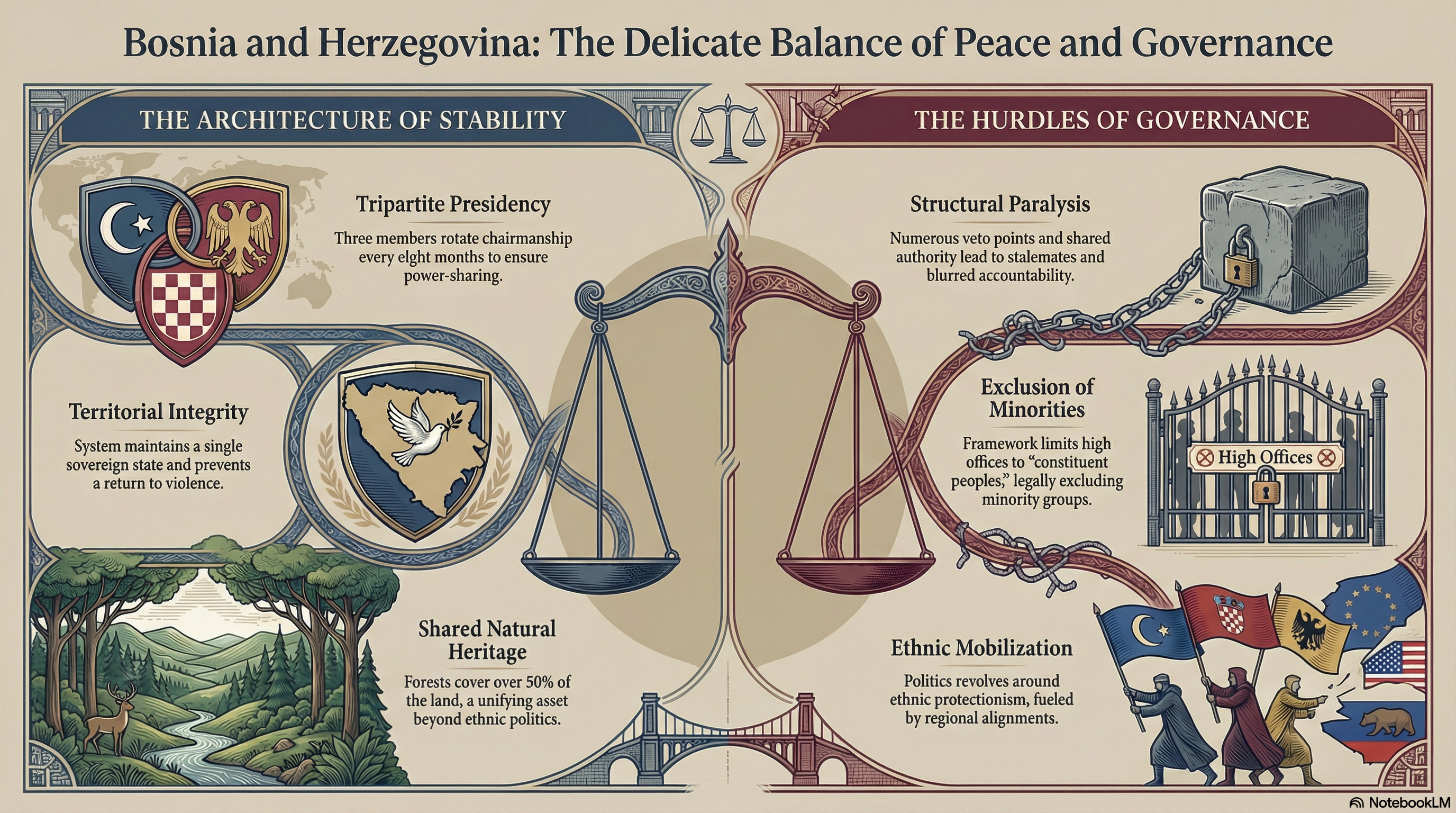
Bosnia is renowned for its natural beauty, with forests covering over half of its land, making it one of Europe’s most forested countries. It hosts a significant population of wild horses, numerous rivers, waterfalls, and wetlands, including protected national parks. This natural heritage is a shared asset that transcends ethnic divisions.
Politically, the three main communities have distinct international orientations: Bosniaks tend to align with the West and the United States, Croats lean toward the European Union, and Serbs maintain close ties with Serbia and Russia.
A Constitution Designed to Prevent War
Bosnia and Herzegovina’s political system is often described as “complicated,” but this complexity is not accidental—it is a deliberate peace architecture born from the trauma of the 1990s war. The Dayton Peace Agreement of 1995 ended the conflict and established a constitution designed less to govern efficiently and more to prevent a return to violence.
The country is a single sovereign state composed of two main entities—the Federation of Bosnia and Herzegovina and Republika Srpska—plus the Brčko District. The Federation itself is subdivided into cantons, adding layers to an already complex system.
At the heart of the state is the tripartite Presidency, consisting of one Bosniak, one Croat, and one Serb member, who rotate the chairmanship every eight months during a four-year term. This arrangement was not chosen for elegance or simplicity but as a safeguard against domination by any one group. It embeds power-sharing into the very fabric of the state to ensure that no ethnic community can be excluded from its own future.
The Achievement: Holding the State Together
This system’s greatest success is its ability to keep Bosnia and Herzegovina territorially intact and functioning as a single state. Despite its many flaws, it has maintained elections, parliaments, budgets, and daily governance, preventing constitutional disputes from escalating back into armed conflict. This achievement, while often overlooked, is significant.
The Cost: Paralysis and Political Stalemate
However, the same safeguards that prevent domination also create a structural temptation toward paralysis. The multiplication of veto points and shared authority often leads to disputes, blurred responsibilities, and a culture of blame-shifting. Accountability becomes elusive, as failures can be attributed to other entities or political actors. In a business, this would mean chronic underperformance; in a state, it results in persistent stalemate.
The Moral Dilemma: Exclusion of Minorities
Bosnia’s political system recognizes three “constituent peoples,” but this framework excludes minorities and those who do not fit neatly into these categories. European human rights bodies have repeatedly criticized Bosnia for this discrimination, especially regarding access to high political offices. This exclusion challenges the very principle of equal citizenship and equal standing before the law.
Identity Politics and Ethnic Mobilization
Ethnic and religious identities are deeply intertwined with Bosnia’s politics. The three main groups—Bosniaks, Croats, and Serbs—are closely associated with Islam, Catholicism, and Orthodoxy, respectively. While not every citizen is intensely religious or tribal in outlook, political mobilization often draws on these identities, histories, and symbols. When ethnicity is constitutionally central, politics naturally becomes ethnically expressive.
Internal and External Dynamics
Bosnia’s internal political competition often revolves around ethnic protectionism. Externally, the country remains under the supervision of the Office of the High Representative, an international institution established to oversee Dayton’s implementation. While this external oversight has helped maintain stability, it can also encourage local leaders to posture as defenders against “foreign interference” while relying on international authority to prevent systemic collapse.
More destabilizing, however, are the external patronage networks and political alignments. Bosniak, Croat, and Serb leaders often look to different regional powers—Western allies, the EU, Serbia, or Russia—for support. This external influence sometimes encourages defiance of state institutions, leading to constitutional crises over the authority of courts, police, and the international overseer.
The Way Forward: Building Legitimacy Through Function
A sudden overhaul of Bosnia’s constitution is unlikely. Instead, progress will come through the slow rebuilding of legitimacy based on effective governance. The rule of law is not an abstract ideal but a practical necessity in a society marked by suspicion and layered power. Credible courts, transparent procurement, consistent anti-corruption measures, and impartial public administration can reduce the emotional need for ethnic vetoes and protectionism.
Cooperation Rooted in Shared Interests
Cooperation becomes easier when tied to tangible benefits. Infrastructure projects, local investments, job creation, education reform, and health system improvements are not just policy areas—they are shared interests that can unite communities. While unity rhetoric often fails, practical successes in governance can shift incentives quickly by giving citizens concrete reasons to support cooperation.
Bosnia’s Shared Natural Heritage: A Unifying Story
Bosnia’s abundant forests, rivers, and national parks offer a shared story beyond ethnic divisions. With over half the country covered by forest, environmental stewardship, sustainable tourism, and rural livelihoods provide opportunities for cooperation based on competence rather than symbolism. Effective governance in these areas can visibly reduce corruption and build trust.
Optimism and Pessimism: The Dual Reality
The pessimistic view is familiar: too many veto points, entrenched patronage, corruption, youth emigration, and frequent constitutional crises threaten the country’s stability. If stalemate is rewarded, it becomes normalised.
Yet there is a quieter optimism. Bosnia has survived what many thought impossible. The state remains intact, and people continue to live across ethnic lines despite political efforts to harden divisions. The complexity of the system reflects a choice for coexistence over separation, imperfect though it may be.
Conclusion: The Real Test of Governance
If Bosnia’s constitution was built to stop war, the next challenge is to build a civic culture where war is politically unprofitable. This will not come from forced unity or empty speeches but from institutions that work well enough for citizens to trust law more than tribe. Ultimately, governance is not judged by neatness on paper but by whether it makes ordinary life dignified.
 Maq Masi Blog
Leave a comment