
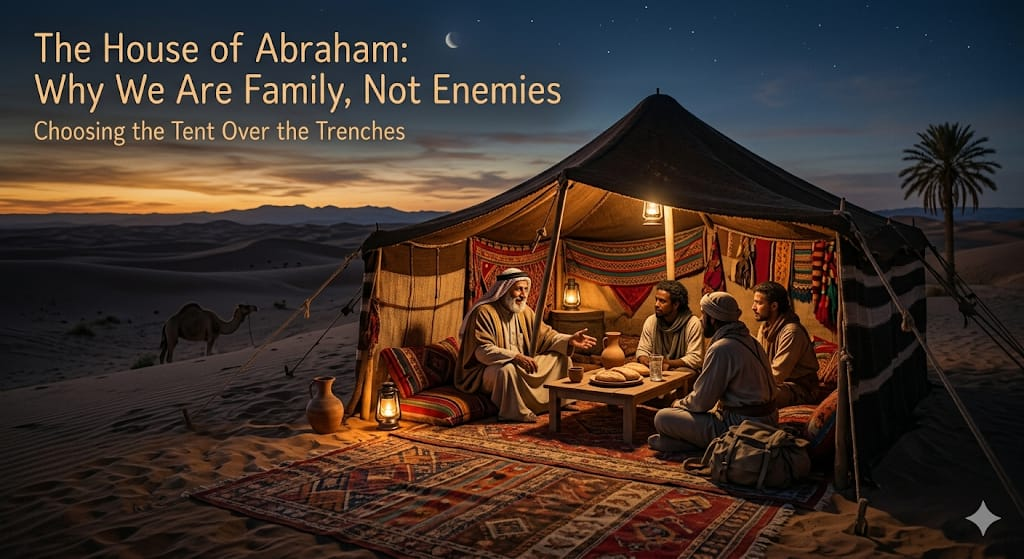
What does it mean to call someone an enemy, when your story begins in the same house?
In an age shaped by headlines, alliances, and carefully drawn borders, it has become easier to inherit division than to question it. We are told who stands with us and who stands against us. We are taught to read conflict through the lens of power, territory, and identity. Yet beneath these narratives lies a quieter, older truth—one that does not belong to politics, but to memory.
Long before states were formed and disputes were institutionalised, there existed a shared story. Not merely of belief, but of origin. The traditions that shaped vast parts of our world do not begin in separation, but in lineage. The figure of Abraham, or Ibrahim, stands not as a symbol of division, but as a point of convergence. Through his two sons—Isaac and Ishmael—emerge lineages that would later shape Judaism, Christianity, and Islam. Over time, theology diverged, identities solidified, and histories took different paths. But the origin remained singular.
This shared origin is not an abstract idea. It is preserved across the very texts that define these traditions. In the Torah, Abraham’s tent stands open as he welcomes unknown visitors with water and rest. The Bible carries forward the same memory, urging believers not to forget hospitality, for in welcoming strangers, one may unknowingly welcome something greater. The Quran echoes this scene, describing honoured guests arriving to Ibrahim, whom he serves without hesitation or suspicion.
Different scriptures, different languages, yet the same moment is remembered.
This is where the idea of the “house” finds its meaning. It is drawn from this shared ancestry and shared narrative—a family that grew, disagreed, separated, yet never ceased to be connected. A house divided is still a house.
This is not merely theological reflection. It is also biological and human. Across continents and cultures, we share more than belief systems; we share genetic continuity, emotional instincts, and social structures. The language of kinship—brotherhood, family, lineage—is not poetic exaggeration. It reflects a deeper reality that predates religion itself.
And yet, what have we done with that inheritance?
The image that endures most powerfully is not one of doctrine, but of a tent in the desert. A space without walls, without suspicion, without interrogation. When strangers approached, they were not assessed, categorised, or rejected. They were received. Water was offered before questions. Rest before judgement. Dignity before difference.
Across traditions, this moment is preserved with remarkable consistency. Not as myth, but as instruction. The stranger is not an intrusion, but a test of character. Hospitality is not generosity; it is obligation.
Somewhere along the way, that obligation has been replaced by caution, then by suspicion, and finally by hostility. The tent has been replaced by trenches.
What we now call realism often disguises a deeper failure. We have learned to justify division with language that appears rational—security, sovereignty, strategic interest. These are not meaningless concepts. They matter. But when they become the sole framework through which we understand human interaction, something essential is lost.
The value of life itself becomes conditional.
And yet, even here, the same traditions speak with a clarity that modern discourse struggles to match. The command not to take life, the blessing of peacemakers, and the idea that saving one life is akin to saving all humanity—these are not isolated teachings. They are reflections of a shared moral foundation that places human life beyond negotiation.
The difficulty is not in understanding these principles. It is in applying them when they are most inconvenient.
It is easy to speak of shared humanity in moments of peace. It is far more difficult when fear dominates, when grief is fresh, when narratives of blame are readily available. Yet this is precisely when such principles matter most.
Consider the ordinary individual, removed from the abstractions of statecraft. A parent in any part of the world does not experience fear differently because of geography. The instinct to protect, the anxiety of uncertainty, the grief of loss—these are constants. They do not recognise borders. They do not respond to political alignment.
And still, we persist in categorising lives as if their value were negotiable.
Perhaps the deeper issue is not conflict itself, but the framework through which we understand it. When we begin with separation, everything that follows reinforces distance. When we begin with shared origin, even disagreement is contextualised differently.
To recognise a shared lineage is not to deny difference. It is to place difference within a broader structure of connection.
This is where the idea of the house becomes significant. Not as a physical space, but as a conceptual one. A house implies relationship. It implies responsibility. It implies that actions taken within it reverberate beyond the individual.
When conflict occurs within a house, it is not merely a dispute between parties. It is a fracture that affects the entire structure.
The question, then, is not whether conflict will exist. It always has. The question is whether we approach it as strangers in opposition or as members of a shared inheritance attempting to resolve what has been broken.
One approach leads to perpetual escalation. The other, at least, leaves room for reconciliation, coexistence, and a restoration of human value grounded in both shared ideas and shared biology.
Returning to the metaphor of the tent is not an exercise in nostalgia. It is a recalibration. It asks us to consider what it would mean to prioritise dignity before judgement in a world that has normalised the reverse.
The house has not disappeared. It has simply been forgotten.
And perhaps the most urgent task is not to build something new, but to recognise what has always been there—waiting, quietly, for us to return.
 Maq Masi Blog
Leave a comment