
We know the pattern from history. Every great empire has an end. The sun set on Great Britain. The Dutch, the Spanish, the Ottomans all faded from dominance. After the Cold War, the Soviet Union collapsed, leaving the United States as the sole global superpower.
Yet dominance is not permanent. It is shaped by underlying structures that evolve over time.
The question is not whether American primacy will diminish, but how—and whether any state possesses the capacity to replace it. In an environment where the objectives of major geopolitical conflicts are often debated or unclear, it becomes necessary to move beyond immediate narratives and examine the foundations of power itself.
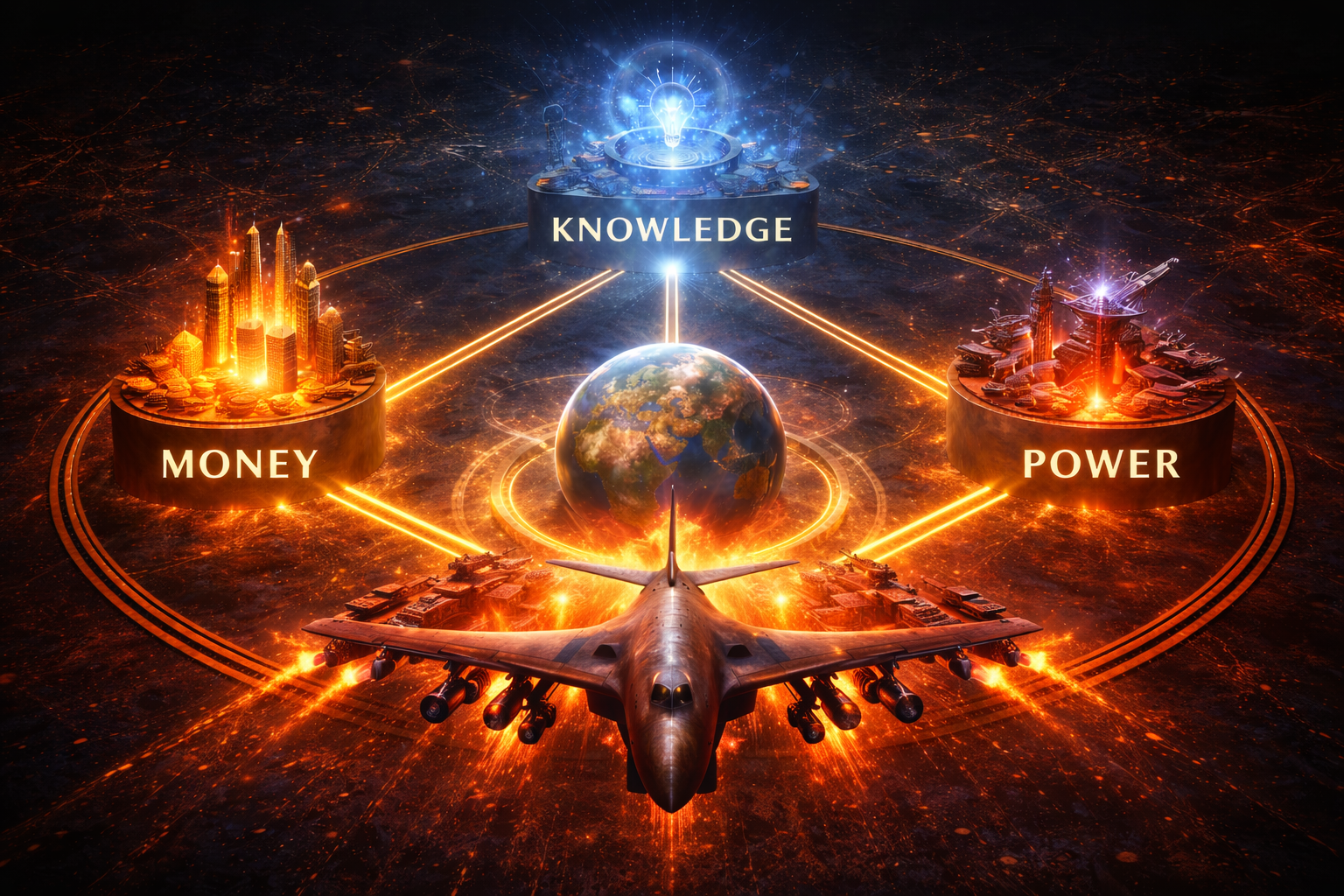
At its core, global dominance rests on three interdependent elements: money, knowledge, and power.
Money refers to the ability to generate and sustain economic activity through trade, industry, and financial systems. Knowledge encompasses education, research, and the capacity for innovation. Power reflects military capability and the ability to secure interests, including the protection of supply chains and strategic assets.
These elements are mutually dependent. Economic strength without knowledge limits long-term growth. Knowledge without power leaves systems exposed. Military capability without economic support cannot be sustained. Durable influence requires the alignment of all three.
Viewed through this framework, the current global landscape reveals important distinctions.
China has developed significant economic capacity, invested heavily in technology, and expanded its military capabilities. However, its strategic posture has focused primarily on domestic stability and regional priorities. While this approach has strengthened its internal position, it differs from the outward-facing model historically associated with global leadership.
Europe retains substantial economic strength and intellectual capacity. In recent years, it has taken steps to reduce reliance on external energy sources and to shape its own economic policies. At the same time, its political and military structures remain decentralised, which limits its ability to act as a unified strategic actor.
India represents a long-term case of potential. Its population size, economic growth, and expanding knowledge base provide a foundation for future influence. However, structural challenges, including uneven development and the outward movement of skilled labour, continue to affect its trajectory.
Other advanced economies demonstrate similar imbalances. Some maintain strong technological and industrial capabilities but operate within constrained defence frameworks. Others possess financial strength but rely on external systems for security and expertise. In each case, incomplete alignment across the three elements limits the extent of their influence.
A smaller group of states presents a different pattern.
Russia retains significant military capability and natural resources, though its economic performance has faced sustained constraints. Iran combines demographic scale with growing domestic capabilities in certain sectors, while also operating under long-term economic restrictions. Israel, despite its limited size, demonstrates a high concentration of technological development, economic innovation, and military capability within a defined regional context.
These examples illustrate that alignment does not always occur at a global scale. In many cases, it develops regionally.
Recent geopolitical developments also highlight a broader dynamic. Actions taken during conflicts have extended beyond immediate military objectives to include infrastructure, industrial systems, and technological capacity. This suggests that competition between states increasingly involves not only present capabilities, but also the long-term conditions that enable future power.
At the same time, internal factors play a growing role. Sustained global engagement requires domestic support. In many countries, public attitudes towards extended external commitments are evolving, influencing how power is projected and maintained.
The emerging global order is therefore unlikely to be defined by a single dominant successor.
Power does not always transfer directly from one state to another. It can fragment, weaken, or re-emerge across multiple regions. What is more likely is a distribution of influence, where different states shape outcomes within their respective spheres.
Within this context, some countries are strengthening their positions regionally, while others continue to expand economically and technologically within existing constraints. No single state currently demonstrates full alignment across all three elements at a global level.
In the final analysis, the structure of dominance remains consistent.
Money enables economic reach.
Knowledge enables innovation and adaptation.
Power enables security and continuity.
Where these three elements align, influence grows. Where one is limited, influence is constrained.
This is not the disappearance of power.
It is its gradual reconfiguration—guided by the same principles that have shaped every period of dominance before.
 Maq Masi Blog
Leave a comment