
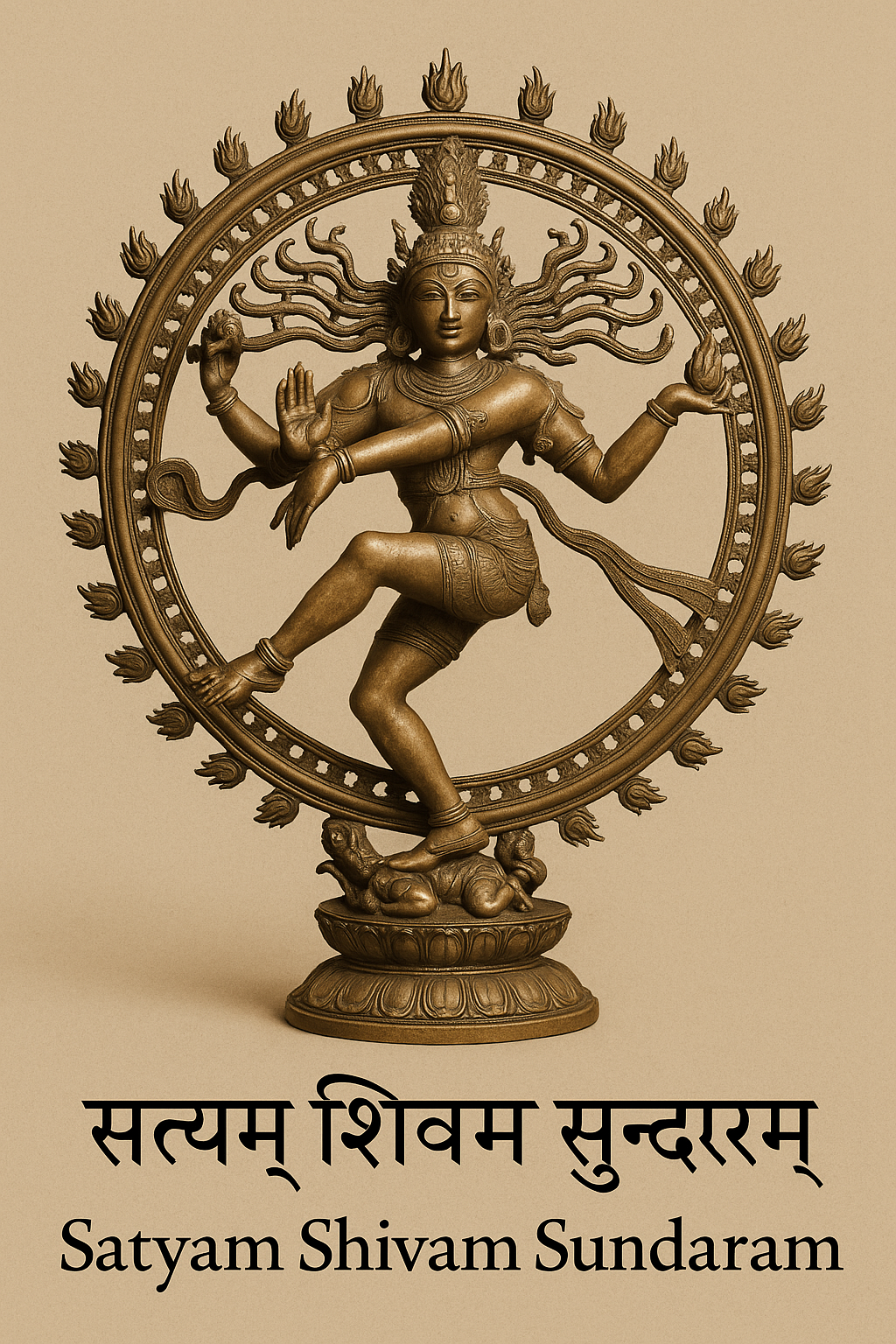
In a world fractured by haste, spectacle, and short-term gain, what compass can still guide us toward a life of substance? Not merely of achievement or appearance, but one that feels rightly lived — inwardly coherent, socially responsible, and quietly extraordinary?
The Sanskrit triad Satyam Shivam Sundaram — truth, goodness, beauty — is one such compass. It does not offer easy answers, nor promise comfort. Instead, it sketches a moral geometry: a way of aligning our words with reality, our actions with decency, and our surroundings with harmony. It is not bound to a single religion or tradition. It is a principle that has quietly endured across centuries — through scripture, art, activism, education, and human struggle — because it speaks to what it means to live well.
The Origins: From Verse to Virtue
The phrase first appears in the Svetasvatara Upanishad (Chapter 4, Verse 14), describing the nature of the Absolute. But over time, Satyam Shivam Sundaram moved from the metaphysical to the moral, from the divine to the daily. No longer just a definition of God, it became a definition of how to live.
Truth (satyam) became more than a statement of fact — it became an ethical discipline. Goodness (shivam) came to mean not only the presence of benevolence but the absence of harm. And beauty (sundaram) became the natural outflow of a life shaped by the first two: beauty that is not painted on, but grown from within.
These ideas were not confined to Sanskrit scholars. They found their way into the conduct of Jain ascetics, the service ethics of Sikh communities, the grace of Japanese tea ceremonies, the simplicity of Gandhian living, and even the design of modern architecture and public space. That is their strength: they endure by adapting. And they guide not by decree, but by example.
Satyam: The Force of Truth in a Fragmented World
To live in truth is not simply to state what is factually accurate. It is to stand where what you think, what you say, and what you do are in alignment. In the age of misinformation and manufactured persona, truth becomes radical.
In Jain monastic ethics, satya is among the five central vows, practiced even in thought. To utter falsehood — even gently — is seen as a crack in the foundation of one’s being. Likewise, the Buddhist precept of right speech (samyak vac) emphasises not only honesty but helpfulness, timing, and tone.
In secular terms, we might see this in a journalist like Maria Ressa standing firm against misinformation. Or in a parent who admits uncertainty rather than feigning moral authority. These are not heroic acts. They are human ones — but ones that require courage.
And that is the test of satyam: not whether it is easy, but whether it liberates.
Practical ways to live satyam: Keep a values journal, practice radical honesty with kindness, verify before you share, and honour your word even in small matters.
Shivam: The Grace of Goodness as Daily Practice
Goodness often gets dismissed as softness. Yet the most enduring forms of strength are forged in gentleness. Shivam, traditionally associated with auspiciousness and the principle of beneficial presence, is best understood as cultivated goodness — not naive, not performative, but chosen.
Communities across time have upheld shivam as lived social ethics. In Sikhism, seva — selfless service — is not an accessory to faith, but its core. In Jewish traditions, tikkun olam (repairing the world) embodies goodness as active responsibility. In Ubuntu philosophy from Southern Africa, humanity is not measured by possessions, but by shared wellbeing.
Even outside formal systems, we find shivam in action: a neighbour who checks on the elderly, a company that chooses fair wages, a young activist planting trees in a degraded street. These are the acts that hold the moral thread of a society together.
Practical ways to live shivam: Volunteer an hour each week, offer help without being asked, practise fair trade, and use your skills to uplift others without seeking recognition.
Sundaram: Beauty as Moral Expression
Of all the three, sundaram is perhaps the most misunderstood. Modern culture has reduced beauty to surface — filtered images, curated aesthetics, branded elegance. But in this triad, beauty is not cosmetic. It is consequential.
When truth and goodness are present, beauty follows. It reveals itself in form, in rhythm, in presence. We see it in the architecture of old stepwells, in the fluidity of Bharatanatyam, in the serenity of a Japanese rock garden. But we also see it in a well-run home, in a just workplace, in the small rituals of care that lend dignity to the everyday.
Beauty, in this deeper sense, becomes the visible proof that something was done with attention, proportion, and care.
Practical ways to live sundaram: Add fresh plants to your living space, take a mindful walk without headphones, pause to appreciate patterns in nature, create one thing a week with your hands or heart.
Communities That Embody the Triad
What makes Satyam Shivam Sundaram more than philosophy is that it has been lived. Entire communities have sustained their cohesion, creativity, and conscience by upholding this triad — not in theory, but in structure.
Jain monks integrate all three in their ascetic ethics: satyam in their speech, shivam in their non-violence, sundaram in their minimalism. Sikh volunteers embody seva as a ritual of collective dignity. Japanese tea masters reflect harmony in preparation and presence. Scandinavian libraries offer beauty in access and silence, run by public funds with honest governance. Architects like Anna Heringer design schools with local materials, balancing truth, goodness, and visual harmony.
These are modern embodiments of Satyam Shivam Sundaram. They show us that the triad is not locked in the past. It is fully alive, wherever people choose to live by it.
The Fulfilment It Offers
To walk the path of Satyam Shivam Sundaram is not to seek fame, reward, or certainty. It is to create an inner life that is resilient, and an outer life that is trustworthy. It is to live in such a way that when others encounter you, they feel not just seen — but safe.
It offers fulfilment not through achievement, but through alignment. You do not have to wonder if you’re on the right path — you become it.
And in that becoming, something remarkable occurs. Not spectacle. Not applause. But clarity. Depth. And yes — beauty.
Not the beauty of mirrors, but of meaning.
Today, try one act of truth, one gesture of kindness, and one moment of beauty. Begin where you are. The triad awaits.


 Maq Masi Blog
Leave a reply to Maq Cancel reply