
Why Do Different Homoeopathic Preparations Use Different Ethanol Concentrations?
Understanding Homoeopathic Manufacturing Under the European Pharmacopoeia
Key Takeaways
- Different homoeopathic preparations do not necessarily use the same ethanol concentration.
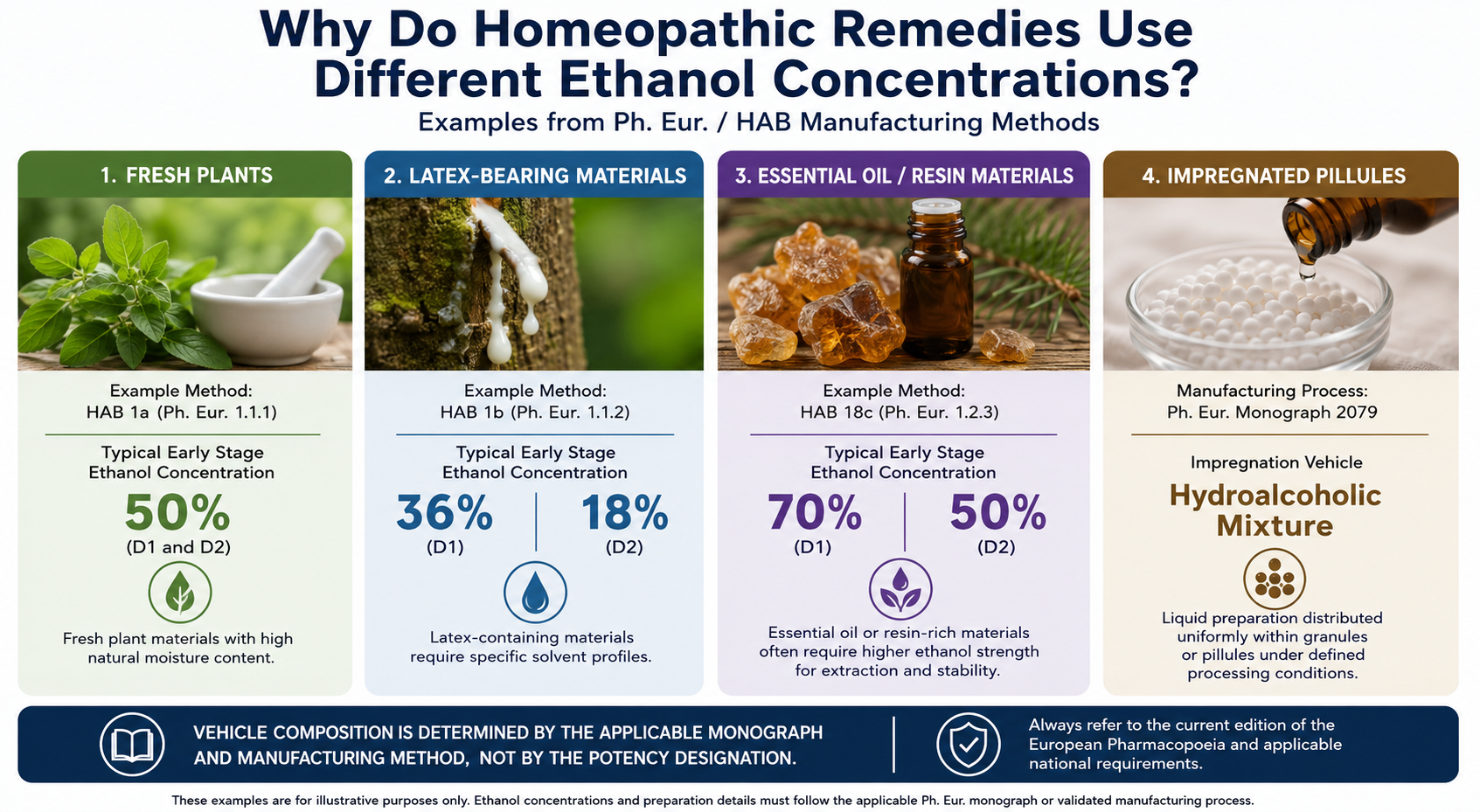
- Vehicle composition is determined by the applicable European Pharmacopoeia (Ph. Eur.) monograph and manufacturing method.
- Fresh plants, dried materials, resin-rich materials and latex-bearing materials may require different preparation approaches.
- Early dilution steps are method-specific and are not governed by a single universal formula.
- The Ph. Eur. contains separate monographs for potentisation methods, impregnated preparations and coated pillules.
- Uniformity of impregnation is an important quality attribute and must be demonstrated through validated manufacturing processes.
Introduction
Many people assume that all homoeopathic medicines are prepared using the same dilution process and the same alcohol concentration. In reality, the European Pharmacopoeia (Ph. Eur.) describes a range of manufacturing methods that vary according to the nature of the starting material and the applicable monograph.
Different homoeopathic preparations use different ethanol concentrations because the applicable Ph. Eur. monograph, the nature of the starting material, and the manufacturing stage all influence the required vehicle composition. In some cases, a hydroalcoholic mixture is needed for extraction or stability; in others, a different vehicle may be specified for later preparation steps.
The concentration of ethanol used during manufacture is determined by the characteristics of the starting material, the applicable monograph, and the stage of manufacture.
The Role of Ethanol in Homoeopathic Manufacture
Ethanol is widely used in homoeopathic manufacturing because it can:
- Extract constituents from the starting material.
- Help maintain stability during storage.
- Contribute to microbial control during manufacturing and storage.
- Assist in keeping certain constituents in solution.
- Provide a suitable vehicle for subsequent dilution steps.
The concentration used depends on the requirements of the specific preparation method.
Why Are Different Ethanol Concentrations Used?
Fresh Plant Materials
Fresh plants contain varying amounts of natural water. For materials with a high moisture content, the extraction process already incorporates significant quantities of water from the plant itself.
For this reason, some Ph. Eur. methods specify moderate ethanol concentrations during the preparation of the mother tincture and early dilution stages.
Materials Rich in Essential Oils or Resins
Certain plant materials contain constituents that are more readily extracted or maintained in solution using stronger hydroalcoholic mixtures.
As a result, some Pharmacopoeial methods use higher ethanol concentrations during the initial stages of manufacture.
Latex-Bearing Materials
Materials containing latex may require different solvent compositions depending on the applicable monograph and manufacturing method.
Dried Materials
Dried herbal drugs and other dried starting materials are prepared according to the relevant Pharmacopoeial method. The vehicle and solvent system are determined by the applicable monograph and are not identical for all preparations.
Examples of Ethanol Concentrations Used in Selected Ph. Eur./HAB Methods
The European Pharmacopoeia does not prescribe a single ethanol concentration for all homoeopathic preparations. Instead, the concentration depends on the nature of the starting material and the preparation method.
The following examples are taken from selected Ph. Eur./HAB preparation methods and are provided for illustrative purposes only. Manufacturers should always refer to the applicable monograph and current Pharmacopoeial edition when determining the required vehicle composition.
| Method | Typical Material Type | D1 Vehicle | D2 Vehicle |
|---|---|---|---|
| HAB 1a (Ph. Eur. 1.1.1) | Fresh plants with high natural moisture | 50% ethanol | 50% ethanol |
| HAB 1b (Ph. Eur. 1.1.2) | Latex-bearing materials | 36% ethanol | 18% ethanol |
| HAB 2b (Ph. Eur. 1.1.4) | Fresh plants with lower juice content | 36% ethanol | 18% ethanol |
| HAB 18a (Ph. Eur. 1.2.1) | Heat-treated fresh plants | 50% ethanol | 36% ethanol |
| HAB 18b (Ph. Eur. 1.2.2) | Heat-treated fresh plants | 36% ethanol | 18% ethanol |
| HAB 18c (Ph. Eur. 1.2.3) | Essential oil or resin-rich materials | 70% ethanol | 50% ethanol |
| HAB 18d (Ph. Eur. 1.2.4) | Essential oil or resin-rich materials | 50% ethanol | 36% ethanol |
| HAB 18e (Ph. Eur. 1.2.5) | Essential oil or resin-rich materials | 36% ethanol | 18% ethanol |
These examples demonstrate that the vehicle composition is determined by the characteristics of the source material and the applicable Pharmacopoeial method rather than by the potency designation alone.
A preparation manufactured according to HAB 18c may begin with 70% ethanol because stronger hydroalcoholic mixtures are more suitable for materials rich in essential oils and resins. In contrast, a preparation manufactured according to HAB 1a may use 50% ethanol because the fresh plant material already contributes significant quantities of water.
The purpose of these differing solvent systems is to ensure that each preparation is manufactured under conditions appropriate to the characteristics of the starting material and in accordance with the applicable Pharmacopoeial method.
Typical Ethanol Reduction Sequences
Some methods use a gradual reduction in ethanol concentration as manufacture progresses.
Examples include:
| Method | Typical Ethanol Sequence |
|---|---|
| HAB 1a | 50% → 50% |
| HAB 1b | 36% → 18% |
| HAB 18a | 50% → 36% → 18% |
| HAB 18c | 70% → 50% → 36% → 18% |
| HAB 18d | 50% → 36% → 18% |
| HAB 18e | 36% → 18% |
These examples illustrate that the Ph. Eur. does not adopt a single solvent system for all preparations. The vehicle composition evolves according to the method and the characteristics of the starting material.
Why Do Early Preparation Steps Differ?
The first stages of preparation are not defined by a single universal formula and must follow the relevant Ph. Eur. monograph or validated process.
In some methods, the initial decimal (D) or centesimal (C) preparations are produced using alcohol-water mixtures of defined strength. In other methods, different proportions of starting material and vehicle may be specified.
For example, some methods begin with:
- 2 parts mother tincture and 8 parts vehicle.
- 3 parts mother tincture and 7 parts vehicle.
while others use different proportions according to the applicable monograph.
The purpose of these differences is to ensure that the preparation is processed consistently and remains suitable for the next manufacturing step.
For this reason, two homoeopathic preparations may ultimately be supplied as the same potency while having followed different Pharmacopoeial manufacturing methods during the earliest stages of production.
Why Does the Ethanol Concentration Sometimes Change During Manufacture?
Certain methods described in the Ph. Eur. use different ethanol concentrations at different stages of preparation.
This reflects the changing requirements of the manufacturing process. During the early stages, the composition of the starting material may require a particular hydroalcoholic environment. At later stages, different vehicle compositions may be specified by the applicable monograph or manufacturing process.
The exact solvent strength is determined by the relevant monograph or validated manufacturing procedure and should be documented within the manufacturing process and associated batch records.
Impregnated Homoeopathic Preparations
The European Pharmacopoeia includes monographs for impregnated homoeopathic preparations in which preformed granules or pillules are treated with one or more liquid homoeopathic preparations.
The objective is to achieve uniform distribution of the liquid preparation within the dosage units.
Because uniformity is critical, manufacturers validate the impregnation process to demonstrate that the liquid preparation is distributed consistently throughout the batch.
Verification of uniformity may involve validated sampling and analytical testing in accordance with the applicable specification or Pharmacopoeial requirements.
Why Is Alcohol Commonly Used During Impregnation?
Many manufacturers use hydroalcoholic impregnation liquids because they:
- Distribute readily across the surface of granules or pillules.
- Evaporate efficiently during drying.
- Assist process consistency.
- Support microbiological control during processing.
The specific vehicle used for impregnation depends on the manufacturing process and product specification.
Coated Homoeopathic Pillules
The Ph. Eur. also includes a separate monograph for coated homoeopathic pillules.
Unlike simple impregnation, coated pillules are produced using a defined coating process in which the homoeopathic preparation is applied during manufacture of the dosage form.
The coating process is designed to achieve a consistent and reproducible distribution of the preparation throughout the finished product.
The distinction between impregnated and coated dosage forms is important because separate Pharmacopoeial monographs apply to each type of preparation.
Further Reading
Readers interested in the regulatory and manufacturing framework for homoeopathic medicines may consult the following European Pharmacopoeia texts:
Ph. Eur. 1038 – Homoeopathic Preparations
General requirements for homoeopathic preparations and vehicles.
Ph. Eur. 2371 – Methods of Preparation of Homoeopathic Stocks and Potentisation
Preparation methods for homoeopathic stocks and recognised potentisation procedures.
Ph. Eur. 2079 – Impregnated Preparations
Requirements for preparations produced by impregnating granules or pillules with liquid homoeopathic preparations.
Ph. Eur. 2786 – Homoeopathic Pillules, Coated
Requirements for coated homoeopathic pillules.
European Directorate for the Quality of Medicines & HealthCare (EDQM)
Information on the development and revision of European Pharmacopoeia monographs and standards.
Healthcare professionals and manufacturers should always refer to the current edition of the European Pharmacopoeia and applicable national requirements when interpreting or applying Pharmacopoeial standards.
It should also be recognised that while the Ph. Eur. establishes harmonised European standards, certain national pharmacopoeias and historical manufacturing traditions, including the German Homöopathisches Arzneibuch (HAB), may contain additional requirements or methodological detail.
Conclusion
The manufacture of homoeopathic medicines under the European Pharmacopoeia encompasses a range of preparation methods tailored to different starting materials and dosage forms.
The examples provided show that ethanol concentrations can vary considerably between methods, ranging from 18% to 70% during the early stages of manufacture. Likewise, the proportions of mother tincture and vehicle used for the first dilution steps may differ depending on the applicable monograph.
Ethanol concentration, vehicle composition, and the early stages of preparation are determined by the applicable monograph and manufacturing method rather than by a single universal formula. These requirements help ensure that preparations are manufactured consistently, reproducibly, and in accordance with recognised Pharmacopoeial standards.


Leave a comment